Address
304 North Cardinal
St. Dorchester Center, MA 02124
Work Hours
Monday to Friday: 7AM - 7PM
Weekend: 10AM - 5PM
Address
304 North Cardinal
St. Dorchester Center, MA 02124
Work Hours
Monday to Friday: 7AM - 7PM
Weekend: 10AM - 5PM
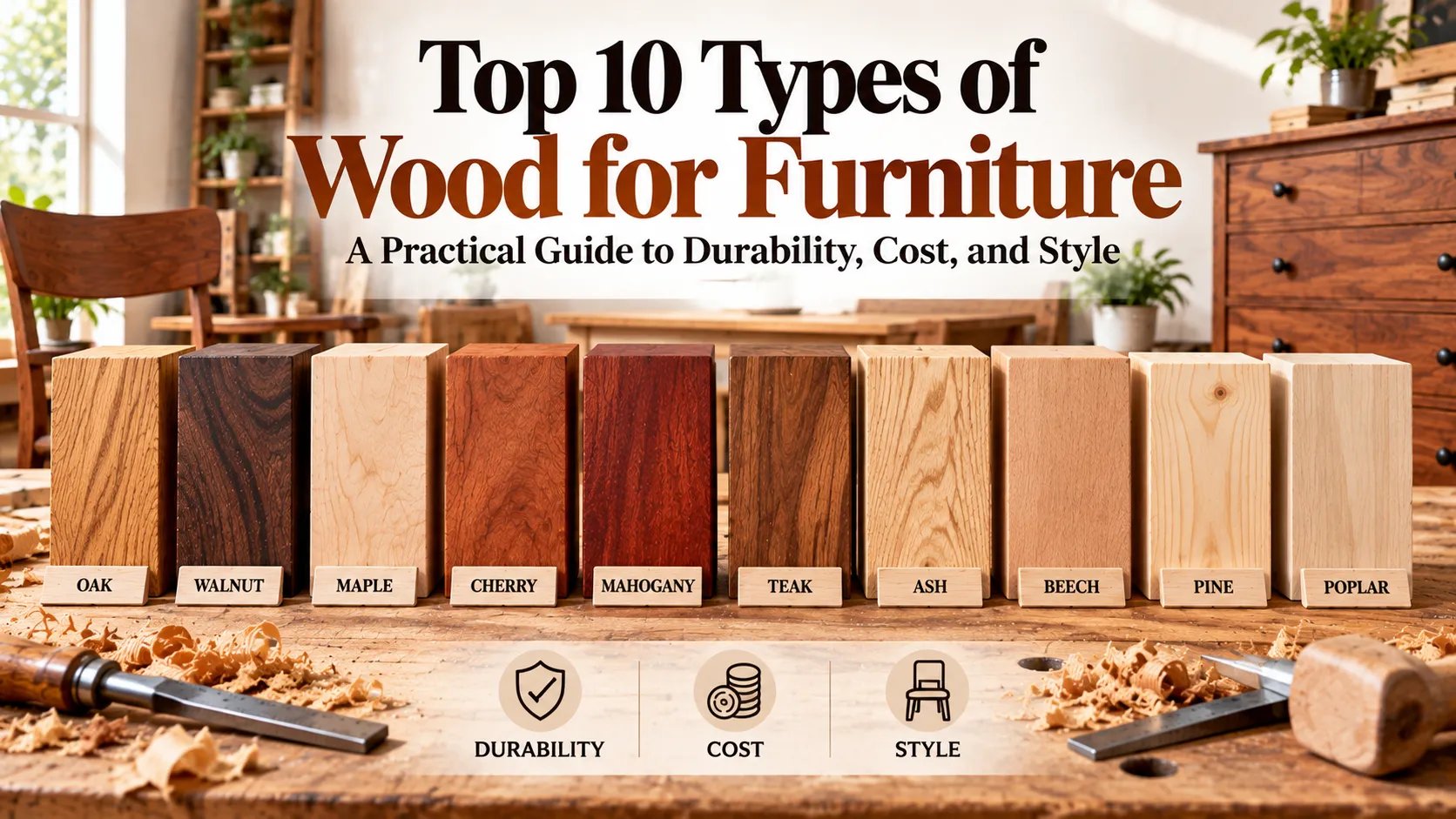
Walk through any furniture showroom and you’ll notice the conversation almost always starts with color. “I want something warm.” “I want something modern.” “I want it to match my floors.” What rarely comes up — but matters far more — is the species of wood underneath the finish. That single decision drives how long the piece lasts, how much it weighs when you move next year, how it survives a spilled glass of wine, and whether it looks better in a decade or worse.
Finish is cosmetic. It can be sanded off, reapplied, or completely changed. Wood species cannot. A pine table refinished to a perfect sheen is still a pine table that dents when your kid drops a fork. A walnut desk with a mediocre factory finish is still a walnut desk that will look gorgeous in twenty years. The wood is the personality; the finish is just the outfit.
This guide ranks the top 10 types of wood for furniture and, more importantly, gives you a framework for choosing between them. Throughout, we’ll use three buying lenses:
After the rankings, you’ll find a full comparison table and a decision matrix organized by furniture type, so you can jump straight to the answer for your specific project.
Before ranking species, it helps to clear up terminology that confuses almost everyone.
Hardwoods come from deciduous trees — trees that drop leaves annually, like oak, maple, and walnut. They’re generally denser and more durable. Softwoods come from coniferous trees like pine, cedar, and fir. They’re lighter and softer, though “softwood” is a botanical category, not a hardness guarantee: some softwoods outperform some hardwoods in specific applications.
Here’s the nuance most guides skip: “hardwood” does not automatically mean harder. Soft maple and hard maple are different species with very different Janka ratings, yet both get sold as “maple.” A piece labeled “hardwood construction” can legally mean almost anything. Ask for the actual species name.
Engineered wood deserves an honest look rather than blanket dismissal. Plywood made with quality hardwood veneer is dimensionally stable, resists warping in humidity swings, and is a legitimate choice for cabinet boxes, drawer bottoms, and shelving. MDF and particleboard are the weaker end of the spectrum — fine for a painted backing panel, risky for anything load-bearing like a table apron or bed rail.
The veneer misconception trips up more first-time buyers than anything else. Veneer is not the same as a veneered particleboard piece. A thin layer of real wood over solid plywood can be a durable, well-engineered product. The problem is when “solid wood” pricing gets applied to furniture that’s actually a veneer skin over MDF. Check edges for repeated grain patterns and inspect undersides for substrate material before you commit.
Appearance: White oak runs from pale tan to light brown with a subtle green-gray cast; red oak leans warmer with a pinkish tone. Both show the bold, open grain and ray fleck that make oak immediately recognizable.
Janka: Roughly 1,360 lbf (white oak), ~1,290 lbf (red oak).
Cost tier: $$
Best for: Dining tables, bed frames, bookcases, anything expected to survive decades of daily use.
Main drawback: The strong grain can look dated in certain modern aesthetics, and red oak’s open pores absorb stain unevenly if not prepped properly. Also heavy — a solid oak dining table is a genuine moving-day problem.
Oak is the workhorse of furniture woods and the default answer for good reason. White oak is denser, more rot-resistant, and the better pick for anything near moisture, including outdoor pieces. Red oak is more affordable and easier to find. Both take stains and paints well, though many buyers now prefer them with a clear finish that shows the grain.
Appearance: Pale, creamy white to light reddish-brown with a fine, subtle grain. Hard maple is often nearly uniform in color, which makes it a favorite for clean, contemporary designs.
Janka: ~1,450 lbf (hard maple), ~950 lbf (soft maple).
Cost tier: $$ to $$$ for hard maple, $ to $$ for soft.
Best for: Butcher block counters, dining tables, chairs, kids’ furniture (hard maple), painted pieces and budget builds (soft maple).
Main drawback: Hard maple resists stain absorption, so it can look blotchy if you try to darken it. Soft maple dents noticeably more and shouldn’t be sold as equivalent.
That hardness gap between hard and soft maple is enormous — nearly 500 lbf — and it’s exactly why species labeling matters. A “maple” table could be either one.
Appearance: Rich chocolate brown deepening to nearly purple-black in some boards, with straight to gently wavy grain. Arguably the most elegant domestic hardwood.
Janka: ~1,010 lbf.
Cost tier: $$$
Best for: Desks, headboards, accent tables, statement dining tables where appearance justifies the price.
Main drawback: Expensive, moderately soft for a premium wood, and it reacts with iron — a wet glass left on a raw or thinly finished walnut surface can leave dark black staining. Use coasters and avoid metal hardware contact on unfinished areas.
Walnut is lighter than oak and far more refined in appearance. If aesthetics matter more than maximum dent resistance, it’s hard to beat.
Appearance: Starts as a warm salmon-pink and darkens to a deep reddish-brown over months of light exposure. Fine, smooth grain with occasional small pitch pockets.
Janka: ~950 lbf.
Cost tier: $$
Best for: Traditional casegoods, dressers, cabinets, dining tables in classic interiors.
Main drawback: It’s softer than its price suggests and dents more than maple or oak. The dramatic darkening also means the piece you buy won’t match the piece you own a year later — charming to some, alarming to others.
Cherry’s patina is its defining feature. If you want a piece that visibly ages and warms, it’s unmatched. If you want color stability, look elsewhere.
Appearance: Deep reddish-brown with a fine, straight grain and excellent natural luster. The classic furniture wood of the 18th and 19th centuries.
Janka: ~800 lbf (genuine Honduran mahogany).
Cost tier: $$$
Best for: Traditional dining sets, executive desks, heirloom-style casegoods.
Main drawback: Genuine mahogany is expensive and a longtime sustainability concern due to overharvesting. Much “mahogany” furniture today is actually a substitute species like sapele or luan. Ask specifically what you’re buying.
Appearance: Golden brown maturing to a soft silver-gray if left outdoors untreated. Straight grain with a naturally oily feel.
Janka: ~1,070 lbf.
Cost tier: $$$
Best for: Outdoor dining sets, patio benches, boat-grade furniture, shower-adjacent pieces.
Main drawback: Natural oils make it extremely weather-resistant, but teak has also been heavily overharvested. Look for FSC-certified or reclaimed teak, and be skeptical of unusually cheap “teak” furniture.
Appearance: Light blonde to medium brown with a bold, open grain similar to oak. Often used as a lighter, more affordable substitute for oak in modern designs.
Janka: ~1,320 lbf.
Cost tier: $$
Best for: Chairs, bentwood designs, dining tables, anything needing strength with less weight.
Main drawback: Its open grain makes it porous, so it needs decent sealing against moisture. Not as commonly stocked as oak or maple in some regions.
Ash’s combination of hardness and shock resistance makes it a favorite for chair legs and frames — it flexes slightly rather than snapping.
Appearance: Pale yellow to honey-toned with prominent knots and a casual, rustic character.
Janka: ~420 lbf (varies by species).
Cost tier: $
Best for: Kids’ furniture, nightstands, painted pieces, budget bed frames, low-traffic items.
Main drawback: Very soft. It dents, scratches, and gouges easily, and knots can bleed sap through finishes. Pine is a value play, not a durability play.
Appearance: Pale, uniform, with a subtle grain that closely resembles maple — often sold as a maple alternative.
Janka: ~1,260 lbf.
Cost tier: $
Best for: Budget cabinets, interior shelving, painted furniture, plywood cores.
Main drawback: Susceptible to moisture and prone to warping if poorly dried. Often used as a veneer over particleboard, so verify construction before assuming solid wood.
Appearance: Light tan to reddish-brown with a fine, straight grain and small flecks. Clean and modern-looking.
Janka: ~1,300 lbf.
Cost tier: $$
Best for: Bentwood chairs (the classic Thonet-style café chair), stools, children’s furniture, workbenches.
Main drawback: Moves significantly with humidity changes and is prone to warping if not properly seasoned. It also has little natural rot resistance.
| Wood | Janka (lbf) | Type | Cost Tier | Best For | Watch Out For |
|---|---|---|---|---|---|
| Hard Maple | ~1,450 | Hardwood | $$–$$$ | Butcher block, dining tables, chairs | Blotchy staining, heavy |
| Oak (White) | ~1,360 | Hardwood | $$ | Dining tables, beds, outdoor (white) | Heavy, bold grain |
| Ash | ~1,320 | Hardwood | $$ | Chairs, bentwood, dining tables | Porous, regional availability |
| Beech | ~1,300 | Hardwood | $$ | Bentwood chairs, workbenches | Warping, no rot resistance |
| Oak (Red) | ~1,290 | Hardwood | $$ | Budget tables, bookcases | Uneven stain absorption |
| Birch | ~1,260 | Hardwood | $ | Cabinets, shelving, painted pieces | Moisture sensitivity, often veneered |
| Teak | ~1,070 | Hardwood | $$$ | Outdoor furniture, patio sets | Overharvesting, price |
| Walnut | ~1,010 | Hardwood | $$$ | Desks, headboards, statement pieces | Iron staining, softer than price implies |
| Soft Maple | ~950 | Hardwood | $–$$ | Painted furniture, budget builds | Dents easily |
| Cherry | ~950 | Hardwood | $$ | Dressers, classic casegoods | Dents, dramatic color shift |
| Mahogany | ~800 | Hardwood | $$$ | Traditional dining, executive desks | Sustainability, species substitution |
| Pine | ~420 | Softwood | $ | Kids’ furniture, rustic pieces | Very soft, knot sap |
How to read Janka numbers: For furniture, anything above roughly 1,200 lbf handles daily abuse well. Between 900 and 1,200 is fine for low-traffic or decorative pieces. Below 900, expect to see wear — which is perfectly acceptable if the piece isn’t a dining table. Don’t treat the number as an absolute ranking of quality; a low-Janka wood with beautiful grain can be the right choice for the right room.
Rather than re-explaining each species, use the table above alongside these recommendations.
Dining tables: Oak or hard maple. Both handle spills, scratches, and daily use without drama. Budget alternative: soft maple with a durable polyurethane finish, or pine with a tablecloth-friendly design philosophy.
Bed frames: Oak for maximum durability, or hard maple if you want a lighter color. Budget alternative: ash, which offers similar strength with slightly less weight.
Outdoor/patio furniture: Teak is the standard for good reason — natural oils resist rot, moisture, and insects. Budget alternatives: cedar or white oak, both with good decay resistance, or acacia if you accept more frequent oiling.
Kids’ furniture: Hard maple or beech for durability against daily chaos. Budget alternative: pine, ideally painted so dents blend rather than show.
Cabinets and storage: Birch or soft maple for the boxes, with hardwood veneer plywood for stability. Avoid particleboard in load-bearing shelves.
Accent/occasional pieces: Walnut or cherry — these are where aesthetics can take priority over maximum hardness.
Every wood has a personality that emerges over time.
Cherry darkens rapidly in the first six months and continues deepening for years. Walnut deepens more subtly into a richer brown. Oak tends to yellow slightly, especially under oil finishes. Teak left outdoors weathers to a silver-gray unless you oil it annually. These changes aren’t damage — they’re patina, and they’re part of why solid wood furniture outclasses veneer over decades.
Maintenance needs depend more on finish than species:
Refinishing a solid wood piece is realistic if it’s at least ¾ inch thick and hasn’t been sanded repeatedly. Veneered furniture can typically be refinished once, lightly. Particleboard with a printed “wood” layer cannot — at that point, replacing is the smarter financial decision.
The sustainability question is genuinely complicated, and it’s worth more than a one-line label check.
Look for FSC certification. The Forest Stewardship Council sets third-party standards for responsible forestry. FSC-certified wood is not automatically perfect, but it’s a verifiable baseline.
Consider reclaimed wood. Old barn wood, salvaged beams, and decommissioned factory flooring offer character and genuine environmental benefit. Reclaimed pine and oak are both widely available.
Be cautious with mahogany, teak, and rosewoods. These have documented histories of overharvesting and illegal logging. Sustainable sources exist, but the burden is on the buyer to verify.
Fast-growing species are often greener. Pine, bamboo, and rubberwood grow quickly and can be harvested on short cycles, making them more eco-friendly than rare hardwoods in many applications. Bamboo in particular isn’t a wood at all — it’s a grass — but it makes credible furniture when engineered properly.
One actionable tip: Before buying, ask the retailer for the species name and country of origin, and whether the wood is certified. A retailer who can’t answer those questions is either uninformed or avoiding the answer. Both are reasons to walk away.
Confusing veneer with solid wood. As covered earlier, a veneer over quality plywood is legitimate. A veneer over MDF sold at solid-wood prices is not. Check edges, undersides, and end grain.
Ignoring your climate. Softwoods and low-Janka hardwoods dent more in homes with kids, pets, and heavy foot traffic. In humid regions, poorly sealed wood swells and warps. Match species to your actual living conditions, not to a showroom display.
Overlooking weight. A solid oak dining table can weigh over 200 pounds. In apartments, walk-ups, and narrow stairwells, that’s a real logistical problem. Ash, soft maple, and walnut are noticeably lighter options.
Assuming price equals durability. Cherry costs more than maple and is significantly softer. Mahogany is a premium wood with a Janka rating of around 800. Price reflects scarcity, aesthetics, and tradition as much as hardness.
Forgetting about finishing compatibility. Some woods (maple, cherry) stain unevenly and benefit from a pre-conditioner. Others (oak) absorb stain aggressively. Plan your finish before you buy the wood, not after.
Here’s the whole guide compressed into a practical decision process. Ask three questions:
If you want the short answer:
The right wood is the one that matches your room, your habits, and your willingness to maintain it. Get those three aligned, and the finish — and everything else — tends to take care of itself.
What is the most durable wood for furniture?
By Janka hardness rating, hard maple, hickory, and oak rank among the most durable furniture woods, followed closely by ash and walnut. Hard maple typically scores around 1,450 lbf and oak around 1,360 lbf, making both excellent for high-traffic tables, chairs, and bed frames that take daily abuse.
Which wood is best for outdoor furniture?
Teak is the standard answer because its natural oils resist moisture, rot, and insects, but it is expensive and often overharvested. Cedar and white oak are strong alternatives with good decay resistance, and acacia offers a budget-friendly option if you accept more frequent maintenance.
Is oak or walnut better for furniture?
Oak is denser and more scratch-resistant, making it better for heavy-use pieces like dining tables. Walnut is slightly softer but lighter in weight and far more elegant in appearance, so it is preferred for statement pieces like headboards, accent tables, and desks where aesthetics matter more than maximum durability.
What is the cheapest wood for furniture?
Pine is the most affordable solid wood for furniture, followed by birch and soft maple. Pine is a softwood, so it dents more easily, but it is lightweight, easy to work with, and a good choice for kids’ furniture, painted pieces, and low-traffic items like nightstands.
Is solid wood always better than engineered wood for furniture?
Not always. Solid hardwood lasts longer and can be refinished multiple times, but well-made plywood with a hardwood veneer is more stable in humidity and costs less. MDF and particleboard are the weakest options and should generally be avoided in load-bearing furniture.
Which wood is best for a dining table?
Oak, hard maple, and walnut are the top choices. Oak and hard maple handle spills, scratches, and daily use best, while walnut offers a warmer, more premium look if you are willing to accept slightly more care to avoid scratches.
How can I tell if furniture is real solid wood or veneer?
Check the edges for a repeating grain pattern (a veneer sign), look underneath for particleboard or MDF substrate, and examine the end grain where boards meet. Solid wood shows continuous grain through the joint, while veneer ends abruptly at the edge.