Address
304 North Cardinal
St. Dorchester Center, MA 02124
Work Hours
Monday to Friday: 7AM - 7PM
Weekend: 10AM - 5PM
Address
304 North Cardinal
St. Dorchester Center, MA 02124
Work Hours
Monday to Friday: 7AM - 7PM
Weekend: 10AM - 5PM
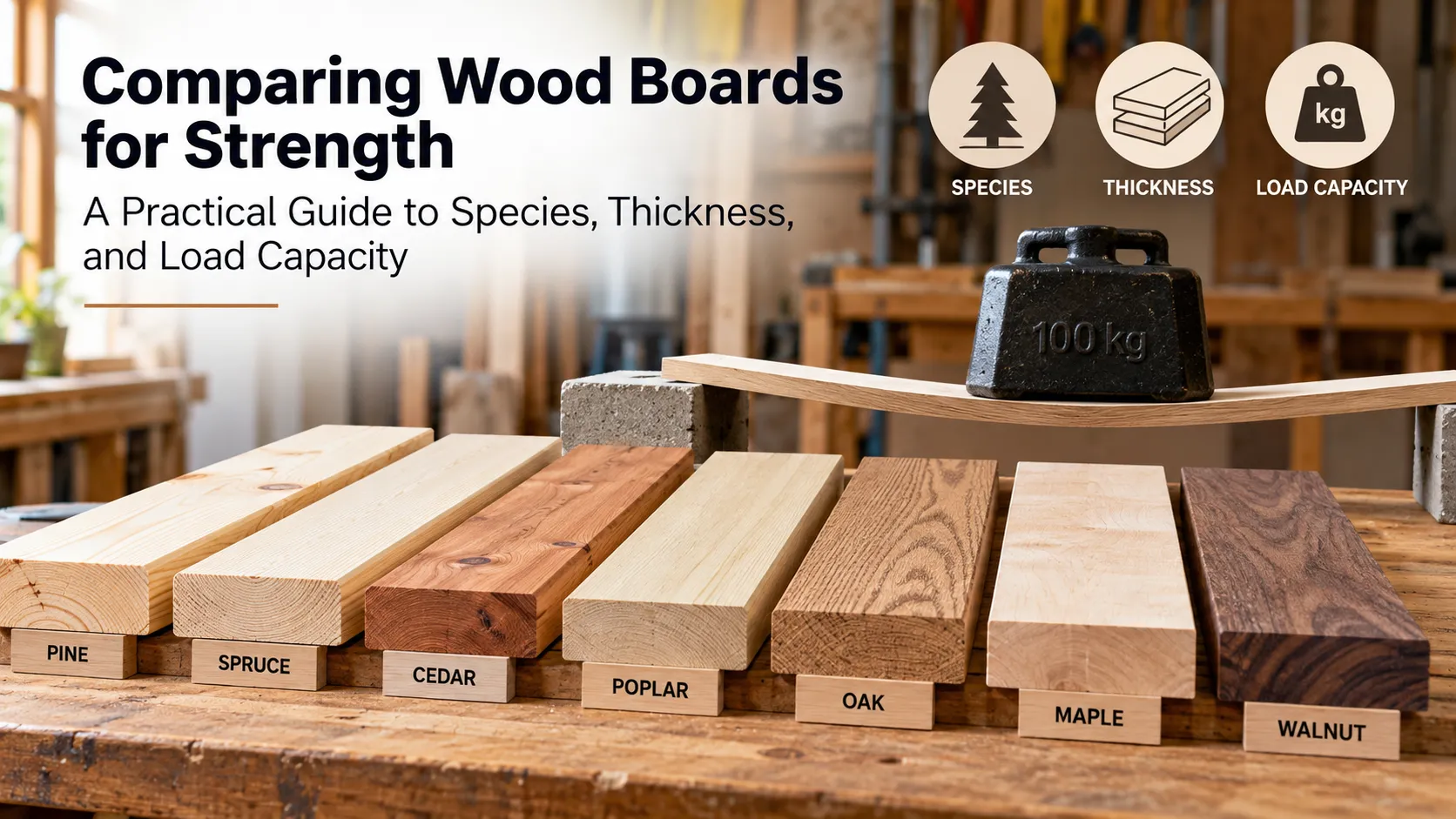
Walk into any lumber yard and you’ll find boards that look nearly identical but behave very differently under load. A 1×8 of oak and a 1×8 of pine might share the same footprint, yet one sags under a row of books while the other barely flexes. Comparing wood boards for strength isn’t about finding a single “strongest” wood—it’s about matching the right species and dimensions to the load, span, and environment your project demands.
This guide breaks that process into three steps: understanding the metrics that matter, reading species data correctly, and applying both to real projects. By the end, you’ll be able to look at any board and estimate whether it can do the job.
Most people start with the Janka hardness test, because it’s the number that gets quoted most often in marketing. That’s a mistake for structural work. Janka measures how much force is required to embed a steel ball into the surface of the wood. It tells you how well a floor or tabletop resists dents. It says almost nothing about whether a board will hold up a load without breaking or sagging.
True structural strength lives in three different metrics—modulus of rupture, modulus of elasticity, and compressive strength parallel to grain—each describing a different failure mode. A species can rank high in one and mediocre in another. That’s the first layer of confusion.
The second layer is that published strength numbers come from small, clear, defect-free specimens tested in a laboratory. Real boards have knots, grain runout, checks, and varying moisture content. A clear test specimen of Douglas Fir might handle 12,000 psi in bending; the board you pick off the rack might fail much earlier because a knot sits right where the stress concentrates. Lab data is a fair comparison tool between species, not a prediction of the exact board in your hand.
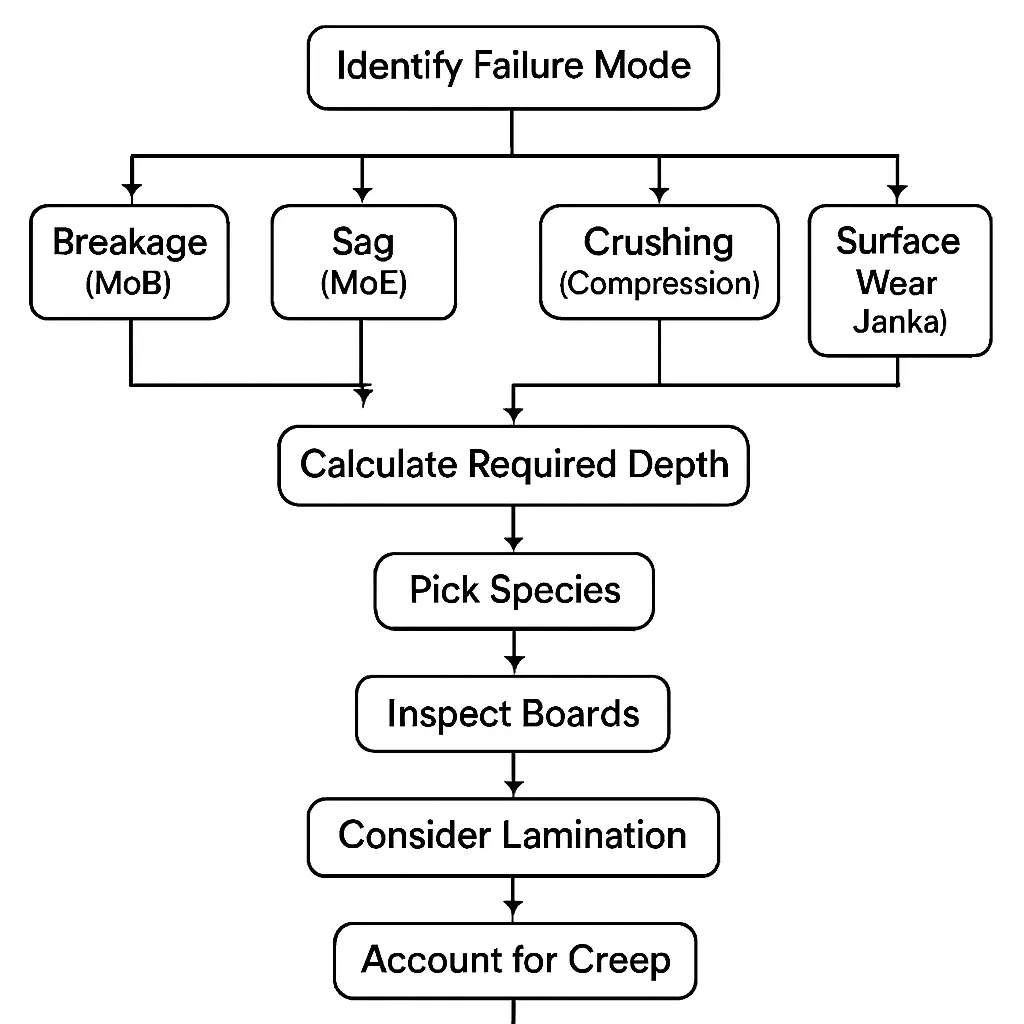
Before you compare anything, answer three questions:
The rest of this article follows a simple framework: the metrics that matter, species data normalized for fair comparison, the outsized effect of thickness, real-world weakening factors, engineered alternatives, and finally application-based recommendations.
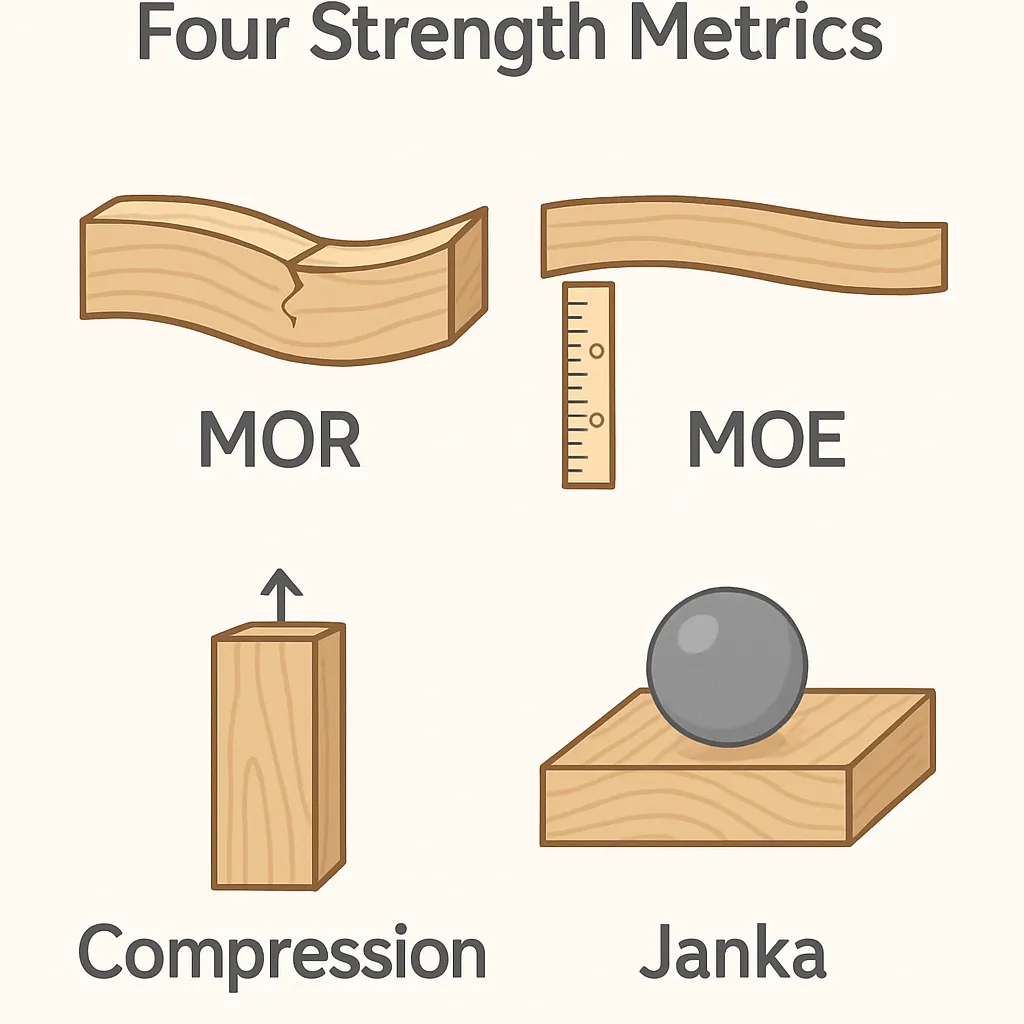
MOR is the stress at which a board breaks under bending. It’s the headline number for shelves, beams, and joists—anything that could snap. Higher MOR means the board can carry more load before catastrophic failure. Hickory leads common domestic species at roughly 20,200 psi; most softwoods sit in the 8,000–14,000 psi range.
MOE measures how much a board deflects under a given load. This is the metric most homeowners actually care about, because a shelf that visibly sags has failed in a practical sense long before it breaks. High MOE means less sag. It’s expressed in millions of psi (Mpsi). Hard maple sits around 1.83 Mpsi, hickory around 2.16 Mpsi, while many softwoods fall between 1.0 and 1.8 Mpsi.
This governs posts, legs, and columns—anything loaded along its length. It’s expressed in psi and depends mostly on cross-sectional area, not thickness in the bending sense. Good compression species include hickory (around 9,200 psi) and hard maple, with dense tropicals like ipe performing even higher.
Janka measures surface indentation resistance. Use it for flooring, tabletops, cutting boards, and wear surfaces. Do not use it to predict bending strength, stiffness, or compression. A board can be extremely hard and still deflect heavily under load.
| Project Type | Primary Metric | Secondary Metric |
|---|---|---|
| Bookshelf | MOE (stiffness) | MOR |
| Floor joist | MOE | MOR |
| Workbench top | MOR + Janka | MOE |
| Table legs / posts | Compression parallel | — |
| Flooring surface | Janka | — |
| Cutting board | Janka | — |
| Beam over a garage door | MOR | MOE |
| Deck railing post | Compression | MOR |
The data below is drawn from the USDA Forest Service Wood Handbook and similar references, normalized to 12% moisture content—the standard baseline that makes species comparisons meaningful. All values are approximate and intended for comparison, not for engineering design without further verification.
| Species | MOE (Mpsi) | MOR (psi) | Compression ∥ (psi) | Specific Gravity | Notes |
|---|---|---|---|---|---|
| Hickory (pecan) | 2.16 | 20,200 | 9,210 | 0.72 | Top domestic strength; hard on tools |
| Hard maple | 1.83 | 15,800 | 7,830 | 0.68 | Excellent all-round; widely available |
| White oak | 1.78 | 15,200 | 7,440 | 0.68 | Strong + rot resistant |
| Osage orange | 1.68 | 15,800 | 8,500 | 0.76 | Very strong; scarce, expensive |
| Ipe | 3.12 | 25,000+ | 13,000+ | 0.91 | Extremely strong; import, costly |
| Cumaru | 2.60 | 21,000+ | 11,000+ | 0.87 | Rot resistant; import |
| Wenge | 1.85 | 16,500 | 9,000 | 0.76 | Hard; moderate availability |
| Yellow birch | 2.02 | 16,600 | 8,170 | 0.62 | Strong for its weight |
| Red oak | 1.64 | 14,300 | 6,760 | 0.63 | Common, affordable, moderate strength |
| Ash (white) | 1.74 | 15,000 | 7,410 | 0.60 | Good strength; tool handles |
| Black walnut | 1.42 | 14,600 | 7,580 | 0.55 | Strong enough; prized for looks |
| Cherry | 1.49 | 12,300 | 7,110 | 0.50 | Moderate; furniture favorite |
| Douglas Fir | 1.95 | 12,400 | 7,230 | 0.48 | Best structural softwood |
| Southern Yellow Pine | 1.98 | 14,100 | 8,470 | 0.55 | Excellent framing lumber |
| Ponderosa Pine | 1.29 | 9,400 | 5,320 | 0.40 | Light, easy to work |
| Sugar pine | 1.10 | 8,300 | 4,700 | 0.36 | Soft, non-structural |
| White spruce | 1.43 | 10,200 | 5,890 | 0.36 | Light framing |
| Hemlock | 1.27 | 10,400 | 5,400 | 0.40 | Framing; moderate |
| Aspen | 1.04 | 8,400 | 4,260 | 0.36 | Light utility |
| Butternut | 1.05 | 6,800 | 3,840 | 0.38 | Soft, carving wood |
| Basswood | 1.00 | 7,400 | 4,730 | 0.38 | Soft, carves easily |
| Teak | 1.55 | 14,000+ | 7,800+ | 0.63 | Rot resistant; expensive |
| Bulletwood | 2.55 | 21,000+ | 12,000+ | 0.90 | Specialty; very strong |
Top by category:
Best value (strength per dollar, typical 2025 pricing): Southern Yellow Pine and Douglas Fir dominate the structural value end. For furniture, hard maple and red oak offer the best balance. Hickory is a strong step up when you need maximum domestic strength without the price jump of exotic imports.
Availability flags: Ipe, cumaru, and bulletwood are tropical imports with significant cost, sourcing, and sometimes sustainability considerations. Osage Orange is prized but rarely stocked—expect to source from specialty dealers. Hickory is common but tends to twist and move more than maple; account for that during milling.
Species data gets you to the starting line. Thickness and width decide the race. Two engineering relationships govern everything here.
Bending strength (MOR) scales with width × depth².
Stiffness (MOE) scales with width × depth³.
The exponent difference is critical. Doubling the thickness of a board increases its bending strength by 4× but its stiffness by 8×. Doubling the width only doubles both. In practical terms, thickness is a far more powerful lever than width when you’re fighting sag.
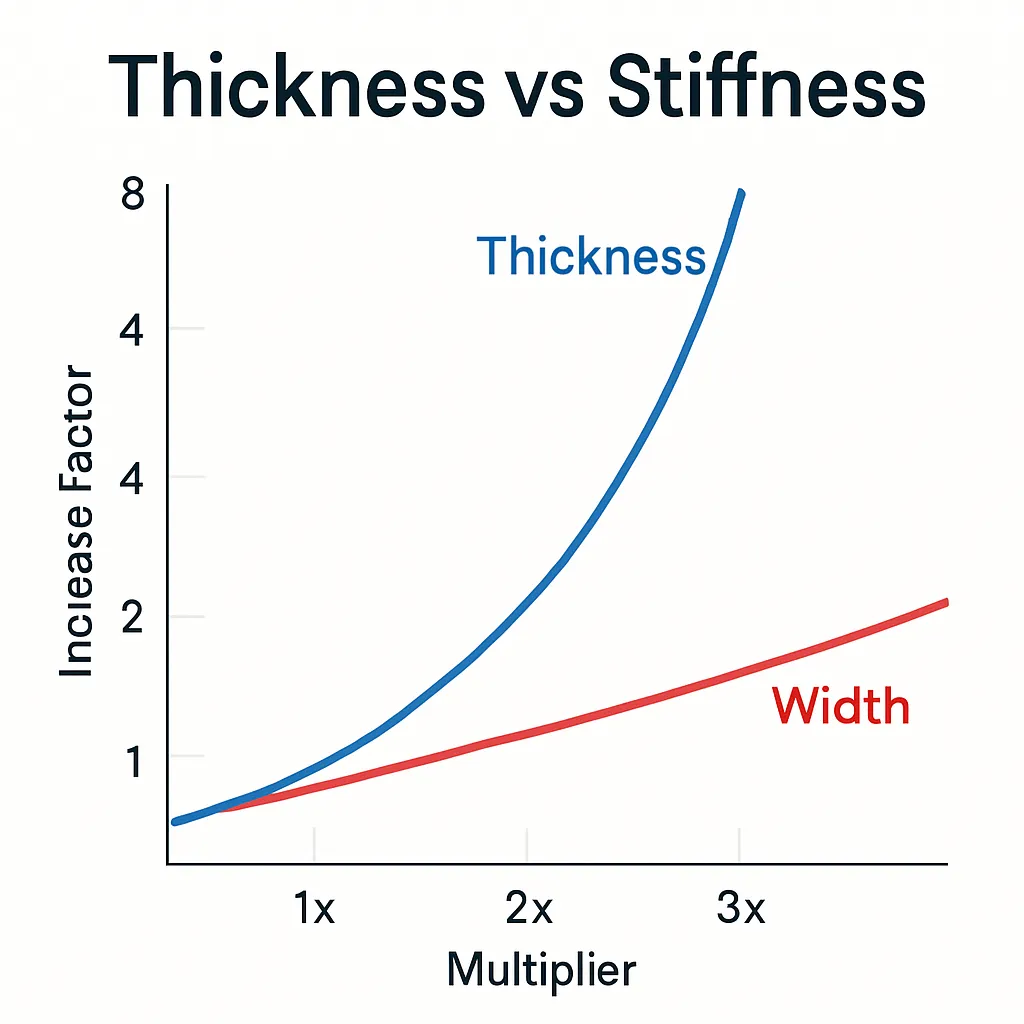
Example: A 1×8 maple shelf sags visibly under book load. A 2×8 of the same species, same span, sags roughly one-eighth as much. A 1×16 of the same species sags only half as much as the 1×8, despite having the same surface area.
Building codes and common practice use deflection limits expressed as a fraction of the span. Two you’ll see often:
Use these as your design target. If a species/thickness combination can’t hit L/360 for a floor, it’s the wrong choice regardless of how strong its MOR looks.
| Application | Span | Species / Thickness | Approximate Result |
|---|---|---|---|
| Bookshelf | 3 ft | Hard maple 1″ × 10″ | Passes L/240 easily |
| Bookshelf | 4 ft | Hard maple 1″ × 10″ | Passes L/240 with moderate load |
| Bookshelf | 4 ft | Douglas Fir 1″ × 10″ | Marginal; sagging likely |
| Bookshelf | 4 ft | Hickory 1″ × 10″ | Passes L/240 comfortably |
| Workbench top | 6 ft | Hard maple 2″ × 24″ | Rigid; minimal deflection |
| Workbench top | 6 ft | SYP 2″ × 24″ | Good with limited load; add aprons |
| Shelf | 2 ft | Pine 3/4″ × 12″ | Fine for light loads |
| Shelf | 2 ft | MDF 3/4″ × 12″ | Sags over time under books |
| Floor joist | 10 ft | Douglas Fir 2×10 | Meets L/360 for residential |
| Floor joist | 10 ft | SYP 2×10 | Meets L/360 comfortably |
The pattern is consistent: thicker stock and higher-MOE species dominate. If you’re caught between species, adding 1/4″ of thickness usually beats switching to a more expensive wood.
Lab data assumes perfect material. Real boards are not perfect. Five factors routinely cut effective strength below published numbers.
Grain runout. Grain that runs diagonally across a board rather than parallel to its length can reduce bending strength by up to 50%. Look at the end grain and trace the growth rings. If the grain exits the face within a few inches, treat that board as a cosmetic piece, not a structural one.
Knots and defects. Knots create stress concentrations. A knot in the tension zone (the bottom edge of a loaded beam) is the most dangerous. Grade rules often limit knot size to less than a third of the face width in structural grades. If your board has knots, place them on top or in low-stress regions.
Moisture content. All published strength data is normalized to 12% MC. As moisture rises toward fiber saturation (about 28–30%), strength drops. Kiln-dried wood at 8–10% MC is measurably stronger than the same species at 15% MC. Green lumber is weakest and will also shrink and twist as it dries.
Joinery and lamination. Edge-gluing two 1×6 boards into a single 1×12 doesn’t add stiffness the way a single 1×12 would, but it does reduce the effect of any single weak board. Laminating vertically—gluing two thin boards face-to-face to make a thicker one—increases stiffness dramatically because depth is what matters. This is how engineered beams outperform solid stock of the same species.
Sustained load (creep). Wood is viscoelastic. A shelf loaded continuously will sag slowly over months and years, even if the load is well below its breaking point. Creep is why a shelf that looked fine at installation appears bowed five years later. Design with a safety factor and, for critical spans, use a lower deflection limit than strictly required.
Engineered boards are not automatically weaker or stronger—it depends entirely on how the load is applied.
Plywood is made from cross-laminated plies. That cross-grain construction gives it two-dimensional stability: it resists expansion, contraction, and splitting far better than solid wood. As a shear panel (a wall, a cabinet back, a drawer bottom), plywood of the same species can outperform solid wood. As a linear beam or shelf, solid wood of the same species and thickness is typically 10–20% stronger in bending because its grain runs continuously along the full length. Plywood’s advantage is stability and fastener holding, not raw bending strength.
MDF and particleboard have very low strength indices—published numbers often fall between 1.6 and 11 depending on the test. They are uniform and stable, which makes them excellent for painted panels and non-structural cabinetry. They are poor choices for shelves over about 24 inches, for anything load-bearing, and for humid environments.
OSB is engineered for shear strength in sheathing applications, not for structural beams. It holds screws poorly in edge grain and swells badly when wet.
| Application | Best Choice | Notes |
|---|---|---|
| Cabinet back panel | Plywood | Rigid, stable, holds fasteners |
| Shelf under 30″ | Plywood or MDF | Adequate for light loads |
| Shelf over 36″ | Solid hardwood or plywood with hardwood edge | MDF sags |
| Workbench top | Solid maple laminations | Best impact and stiffness |
| Subfloor | Plywood or OSB | Engineered wins here |
| Exterior sheathing | Plywood or OSB | Rot resistance matters more than strength |
| Furniture frame | Solid wood | Joinery and grain direction control |
| Drawer bottom | Plywood | Thin, stable, strong in plane |
Practical rule: Use engineered boards when you need wide, stable, flat panels. Use solid wood when you need maximum bending strength along a single axis, or when joinery and finish quality matter more than dimensional stability.
Different projects value different metrics. Here’s how to pick.
Framing and structural work. Prioritize MOE and compression parallel to grain. Douglas Fir and Southern Yellow Pine are the workhorses—both combine respectable stiffness with availability and price. For long spans or heavy loads, LVL (laminated veneer lumber) outperforms solid sawn lumber because defects are distributed across the lamination rather than concentrated in one spot. Avoid knotty utility grades for anything load-bearing.
Furniture and cabinetry. Balance strength, hardness, and workability. Hard maple is the strongest of the easy-to-work domestics. White oak and red oak are close behind with better aesthetics for stained finishes. Cherry and walnut sacrifice some strength for beauty and stability—both are still adequate for typical furniture spans when dimensioned correctly. Hickory is the strength pick if workability is secondary.
Shelving and workbenches. Stiffness (MOE) is the deciding metric. Hard maple, yellow birch, and hickory are all strong choices. A practical and economical alternative is plywood with solid hardwood edging: the plywood provides a stable core, and the edge lamination adds depth to boost stiffness without the weight or cost of a thick solid slab.
Outdoor and heavy-duty. Rot resistance matters as much as strength. Ipe and cumaru are the strength and durability leaders but carry cost and sourcing penalties. White oak and teak are excellent domestic-adjacent choices with proven outdoor performance. Avoid untreated pine, poplar, and most soft maples outdoors regardless of their strength numbers.
Is plywood stronger than solid wood of the same thickness?
It depends on the direction of the load. Plywood is typically stronger and more stable than solid wood of the same species when loaded in its face plane (for example, as a shear panel) because its cross-grain construction distributes stress in two directions. However, for linear bending applications like a shelf or beam, solid wood of the same species and thickness is roughly 10–20% stronger because the continuous grain runs the full length. Plywood’s strength advantage is dimensional stability and resistance to splitting, not pure bending strength.
What is the strongest wood board I can buy at a typical lumber yard?
Among commonly available lumber yard species, hickory and hard maple are typically the strongest in bending and compression. Hickory has a modulus of rupture around 20,200 psi and hard maple around 15,800 psi. For even higher strength, you’d need specialty species like osage orange, ipe, or bulletwood, but these are rarely stocked at general lumber yards and must be sourced from specialty dealers. White oak and red oak are also strong options with better availability.
Does a thicker board always mean a stronger board?
Yes, for a given species and width, increasing thickness always increases strength—but not linearly. Bending strength (MOR) is proportional to thickness squared, while stiffness (MOE) is proportional to thickness cubed. This means doubling a board’s thickness makes it 4 times stronger in bending and 8 times stiffer. However, thickness doesn’t affect compressive strength parallel to the grain, which is a function of cross-sectional area only. Also, very thick boards may be more prone to internal defects and drying stresses.
How does moisture affect the strength comparison between wood species?
Moisture content affects all wood species similarly: strength decreases as moisture content increases up to the fiber saturation point (about 28–30% MC). Published strength data, such as the USDA Wood Handbook, is normalized to 12% moisture content for fair comparison. In practice, a kiln-dried board at 8–10% MC will be slightly stronger than the same species at 15% MC. The key is to compare species using data at the same moisture content—comparing green data from one species to kiln-dried data from another is misleading.
Can I use Janka hardness to compare boards for structural strength?
No. Janka hardness measures resistance to surface indentation and is only useful for predicting wear resistance (for example, flooring and tabletops). It does not correlate strongly with bending strength, stiffness, or compression strength. For example, lignum vitae has a Janka hardness of 4,390 lbf but a lower modulus of elasticity than wenge, which has a Janka hardness of only 1,930 lbf. Use MOE for stiffness, MOR for bending strength, and compression values for load-bearing posts.
What’s the strongest wood for a 4-foot shelf span without supports?
For a 4-foot shelf span, stiffness (MOE) matters more than ultimate strength, because excessive deflection is the typical failure mode. Hard maple (MOE ~1.83 Mpsi) and hickory (MOE ~2.16 Mpsi) are excellent choices. A 1-inch thick board of either species at 8–10 inches deep will support typical book loads with minimal sag. For even better performance, use a 1.25-inch thick board or add a hardwood edge lamination to increase depth without adding much weight.