Address
304 North Cardinal
St. Dorchester Center, MA 02124
Work Hours
Monday to Friday: 7AM - 7PM
Weekend: 10AM - 5PM
Address
304 North Cardinal
St. Dorchester Center, MA 02124
Work Hours
Monday to Friday: 7AM - 7PM
Weekend: 10AM - 5PM
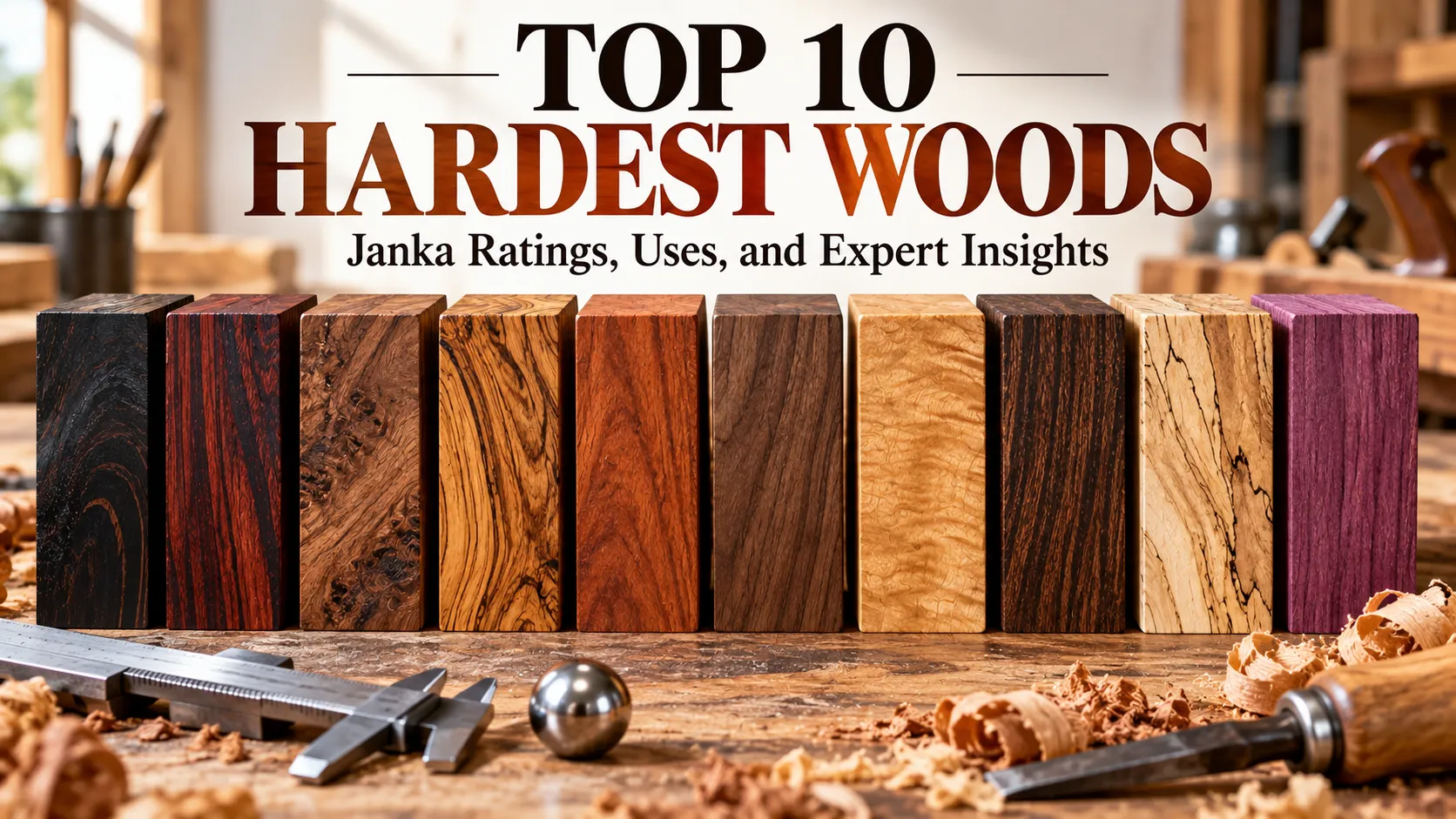
When you’re choosing wood for a floor that needs to survive decades of foot traffic, a deck that faces sun and rain, or a tool handle that takes a beating, hardness becomes more than just a bragging right. It’s a practical measurement that can determine whether your project lasts five years or fifty. But hardness isn’t the whole story, and the world’s hardest woods come with their own set of trade-offs that every woodworker, builder, and DIY enthusiast should understand before committing to a species.
This guide breaks down the top 10 hardest woods on the planet, ranked by the Janka hardness scale, along with their origins, density, typical uses, and the real-world challenges of working with them. You’ll also learn why the hardest wood isn’t always the best wood for your project, and what alternatives make more sense for common applications.
The Janka hardness test is the industry standard for measuring how resistant a wood species is to denting and wear. The test itself is straightforward: a steel ball measuring 0.444 inches (11.28 mm) in diameter is pressed into a wood sample until half the ball’s diameter is embedded. The force required to reach that point is recorded, expressed in pounds-force (lbf) or newtons (N).
A higher Janka rating means the wood resists dents, scratches, and general surface wear better. That’s why the scale is so widely used in flooring comparisons. If you’re choosing between two hardwood flooring options, the Janka rating gives you a reasonable indication of which one will hold up better under daily abuse from furniture legs, pet claws, and high heels.
But here’s where people often get confused: Janka hardness is not a measure of overall strength. It doesn’t tell you how well a wood resists rot, how stable it is across seasonal moisture changes, or how easy it is to cut, sand, and finish. A wood can be incredibly hard and still be a poor choice for outdoor decking if it has no natural decay resistance. Likewise, an extremely hard wood might be so difficult to machine that it’s impractical for furniture.
Hardness matters most in applications where surface wear is the primary concern. Flooring, decking, butcher blocks, tool handles, and workbench tops all benefit from high Janka ratings. In furniture making, hardness is nice but often secondary to workability, grain appearance, and dimensional stability.
The following rankings are based primarily on data from the Wood Database, which compiles Janka ratings from published sources and independent testing. Keep in mind that Janka values can vary depending on the specific sample tested, the moisture content of the wood, and the testing methodology. Some species have wide ranges reported across different studies.
Janka: 3,670 lbf (16,320 N)
Origin: Dry savanna regions of Africa
Density: Approximately 1,270 kg/m³
African Blackwood is technically a rosewood, though its appearance is far darker than most of its relatives. The heartwood is nearly jet black, sometimes with subtle purple or brown streaks. It’s extremely dense and has a fine, uniform texture that takes an exceptional polish.
This wood has been prized for centuries in the making of clarinets, oboes, and other woodwind instruments. Its density and stability make it ideal for applications where precise dimensions must be maintained over time. It’s also used for knife handles, carvings, and high-end furniture inlays. Because of its slow growth and limited supply, African Blackwood is expensive and increasingly regulated.
Janka: 3,710 lbf (16,500 N)
Origin: Southeast Asia, particularly Myanmar and Thailand
Density: Approximately 1,200 kg/m³
Burmese Blackwood, also known as Yindaik, is another dense rosewood species with a deep, dark heartwood. It’s slightly harder than African Blackwood on the Janka scale but shares many of the same working characteristics: it’s heavy, durable, and polishes beautifully.
Common uses include musical instruments, fine furniture, and decorative turnings. Like many Dalbergia species, it falls under CITES trade regulations due to concerns about overharvesting.
Janka: 3,710 lbf (16,500 N)
Origin: Northern South America, especially Venezuela and Colombia
Density: Approximately 1,200 kg/m³
Verawood is often mentioned as a substitute for Lignum Vitae, and for good reason. It shares a similar density and hardness, along with natural oils that make it resistant to moisture and decay. The wood has a distinctive olive-green to brown color that darkens with exposure to light.
Verawood is used for tool handles, mallet heads, bearings, and marine applications. It’s more readily available than genuine Lignum Vitae, though still not a common lumberyard item. Its natural lubricity makes it useful for bushings and other mechanical applications.
Janka: 3,800 lbf (16,900 N)
Origin: Tropical regions of Central and South America
Density: Approximately 1,250 kg/m³
Snakewood gets its name from the dramatic, irregular pattern of dark spots and streaks that resemble snakeskin. It’s one of the most visually striking woods in the world, which makes it highly sought after for knife handles, pool cues, bow risers, and high-end pens.
The wood is extremely dense and hard, but it’s also notoriously difficult to work with. Snakewood has a tendency to crack and split during drying, and it can be challenging to plane without tearout. Its rarity and price put it firmly in the category of specialty woods rather than everyday lumber.
Janka: 3,870 lbf (17,210 N)
Origin: Southern Africa
Density: Approximately 1,220 kg/m³
Leadwood is named for its exceptional weight and density—a cubic foot of dry Leadwood can weigh over 75 pounds. It’s one of the hardest and heaviest woods native to Africa, and it’s also highly resistant to termites and decay.
Traditional uses include carving, furniture, and fence posts. Because the tree grows slowly and is protected in many areas, Leadwood is not commercially harvested on a large scale. It’s more of a collector’s wood or a specialty material for artisans.
Janka: 3,920 lbf (17,440 N)
Origin: Brazil and other parts of South America
Density: Approximately 1,200 kg/m³
Brown Ebony, also known as Brazilian Ironwood, is a dense, durable wood with a warm brown color and fine grain. It’s used for flooring, furniture, and decorative applications where both hardness and appearance matter.
The wood is relatively stable once dried and takes a good finish. However, its density makes it heavy and somewhat difficult to work with hand tools. Power tools with sharp, carbide-tipped cutters are recommended.
Janka: 3,510 lbf (15,620 N)
Origin: Central and South America, especially Brazil and Bolivia
Density: Approximately 1,100 kg/m³
Ipe, often called Brazilian Walnut, is one of the most commercially important hardwoods in the world. It’s widely used for decking because of its exceptional durability, natural decay resistance, and ability to hold up to weather without chemical treatment.
Ipe is dense enough that it sinks in water. It’s also heavy, hard, and somewhat difficult to machine, but its long lifespan and low maintenance make it a favorite for high-end outdoor projects. The wood has a rich brown color that weathers to a silvery gray if left unfinished.
Janka: 3,330 lbf (14,800 N)
Origin: Northern South America, particularly Brazil and Peru
Density: Approximately 1,100 kg/m³
Cumaru, also known as Brazilian Teak, is another top-tier decking wood. It’s slightly less hard than Ipe but still offers excellent durability and rot resistance. The wood has a warm, golden-brown color with an interlocked grain that can produce a striking ribbon figure.
Cumaru is used for decking, flooring, furniture, and structural applications. Like Ipe, it’s dense and heavy, requiring pre-drilling for fasteners. It’s more readily available than many of the ultra-rare woods on this list.
Janka: 4,500 lbf (20,020 N)
Origin: Caribbean and northern South America
Density: Approximately 1,230 kg/m³
Lignum Vitae translates to “wood of life,” a name given for its medicinal properties in addition to its exceptional hardness. For centuries, it was considered the hardest and most durable wood commercially available. It’s so dense that it sinks in water and has natural oils that make it self-lubricating.
Historically, Lignum Vitae was used for propeller shaft bearings on ships, bowling balls, mallet heads, and other applications requiring extreme durability and low friction. Today, it’s listed in CITES Appendix II and is endangered in some regions, making it restricted and expensive. Verawood is often used as a substitute.
Janka: 5,060 lbf (22,500 N)
Origin: Eastern Australia
Density: Approximately 1,100 kg/m³
Australian Buloke, also known as Bull Oak, holds the top spot on most rankings of the world’s hardest woods. Its Janka rating of 5,060 lbf is significantly higher than any other species tested. The wood is so hard that it’s been known to dull chainsaw blades and damage milling equipment.
However, there’s some discrepancy in the data. Some tests report lower averages for Australian Buloke, and the species is endangered and restricted in Australia. It’s not commercially harvested on a large scale, which means it’s more of a curiosity than a practical option for most woodworkers.
Historically, Australian Buloke was used for tool handles, fence posts, and railway sleepers. Today, it’s protected, and sourcing it legally is difficult.
Honorable Mentions: Leadwood, Brown Ebony, and Ipe are sometimes listed in different orders depending on the source. Other notable ultra-hard woods include Black Ironwood (Krugiodendron ferreum) from North America and Quebracho (Schinopsis spp.) from South America.
| Rank | Wood Name | Scientific Name | Janka (lbf) | Janka (N) | Origin | Common Uses |
|---|---|---|---|---|---|---|
| 1 | Australian Buloke | Allocasuarina luehmannii | 5,060 | 22,500 | Eastern Australia | Tool handles, fence posts (historical) |
| 2 | Lignum Vitae | Guaiacum officinale | 4,500 | 20,020 | Caribbean, N. South America | Bearings, mallets, marine applications |
| 3 | Brown Ebony | Libidibia ferrea | 3,920 | 17,440 | Brazil, South America | Flooring, furniture, decorative items |
| 4 | Leadwood | Combretum imberbe | 3,870 | 17,210 | Southern Africa | Carving, furniture, fence posts |
| 5 | Snakewood | Brosimum guianense | 3,800 | 16,900 | Central, South America | Knife handles, pool cues, pens |
| 6 | Burmese Blackwood | Dalbergia cultrata | 3,710 | 16,500 | Southeast Asia | Musical instruments, fine furniture |
| 7 | Verawood | Bulnesia arborea | 3,710 | 16,500 | N. South America | Tool handles, bearings, marine |
| 8 | African Blackwood | Dalbergia melanoxylon | 3,670 | 16,320 | Dry Africa | Woodwind instruments, carvings |
| 9 | Ipe | Handroanthus spp. | 3,510 | 15,620 | Central, South America | Decking, flooring, outdoor furniture |
| 10 | Cumaru | Dipteryx odorata | 3,330 | 14,800 | N. South America | Decking, flooring, structural |
Note: Janka values can vary significantly depending on the specific sample tested, its moisture content, and the testing laboratory. The values above are representative averages compiled from sources including the Wood Database.
Several factors contribute to the extreme hardness of these species. The most important is density: harder woods generally have more wood substance per unit volume, which means more cell wall material packed into the same space. This is why many of the hardest woods sink in water.
Lignin content also plays a role. Lignin is the natural polymer that binds wood cells together and provides rigidity. Woods with higher lignin content tend to be harder and more resistant to compression.
Growth rate is another factor. Slow-growing trees often produce denser wood because the growth rings are tighter and the cells are more compact. Many of the hardest woods come from tropical regions where competition for resources and seasonal stress can lead to slower, denser growth.
Cell structure matters too. Woods with thick-walled fibers and small lumens (the hollow centers of cells) tend to be harder than those with thin walls and large lumens.
It’s also worth clarifying the difference between hardwoods and softwoods. These terms are botanical classifications, not descriptions of actual hardness. Hardwoods come from angiosperm trees (flowering plants), while softwoods come from gymnosperms (conifers). Some softwoods, like yew, are harder than certain hardwoods. The Janka scale is a better indicator of actual hardness than the hardwood/softwood label.
The hardest woods are chosen for applications where durability and wear resistance are critical. Here’s how some of the top species are used in practice:
Not all ultra-hard woods are suitable for every project. Some are so dense and hard that they’re difficult to machine, requiring specialized tooling and slow feed rates. Others are rare, expensive, or restricted by trade regulations. In many cases, a slightly softer wood with better workability and availability is a more practical choice.
Woodworkers often share stories of ruined blades and burned-out router bits when working with these species. One common anecdote involves Ipe: it’s not uncommon for a fresh saw blade to dull noticeably after cutting just a few board feet. This is a reminder that hardness comes with real costs in terms of tool wear and labor.
If you’re planning to work with any of the woods on this list, preparation is key. Here are some practical tips:
Tool Selection: Use carbide-tipped blades and bits. High-speed steel will dull quickly, especially with woods like Ipe or Lignum Vitae. Keep cutters sharp and replace them as soon as they start to dull.
Feed Rates: Slow down. Forcing a blade or bit through dense wood can cause burning, kickback, or tool damage. Let the tool do the work at a controlled pace.
Safety Precautions: Dust from many tropical hardwoods can be irritating or allergenic. Wear a dust mask and eye protection. Some species, like Ipe, have been associated with skin irritation and respiratory issues.
Finishing: Oils and waxes penetrate dense woods slowly. You may need to apply multiple coats or use a thinner finish to get proper adhesion. Some dense woods have natural oils that can interfere with certain finishes.
Pre-Drilling: Always pre-drill for screws and nails. Ultra-hard woods are prone to splitting, and driving a fastener without a pilot hole is a recipe for disaster.
Machinery Wear: Expect accelerated wear on blades, bits, and sandpaper. Budget for replacement costs if you’re working with these woods regularly.
Many of the hardest woods are also among the most threatened. Lignum Vitae is listed in CITES Appendix II and is endangered in some regions. Australian Buloke is protected in Australia. African Blackwood and other Dalbergia species are subject to trade restrictions.
Ethical sourcing matters. If you’re buying these woods, verify the legal status and source. For Lignum Vitae, Verawood is a close substitute with similar hardness and better availability. For decking, Ipe and Cumaru are more commercially viable than many ultra-rare species.
Cost varies widely. Ipe and Cumaru are expensive but accessible. Snakewood, Lignum Vitae, and Australian Buloke are collector’s items, often priced accordingly. For everyday projects, more readily available hardwoods like Hickory, Hard Maple, or White Oak offer a good balance of hardness, workability, and cost.
If you’re working in North America and want to source locally, the hardest domestic wood is Black Ironwood (Krugiodendron ferreum), native to Florida. It has a Janka rating of 3,660 lbf (16,280 N), which puts it in the same league as many tropical hardwoods. However, it’s not commercially available in large quantities.
Other hard North American woods include:
While these woods don’t match the Janka ratings of the global top 10, they’re far more accessible and often more practical for everyday projects.
Choosing the right wood isn’t just about hardness. Consider the following:
Use the Janka scale as a guide, not the sole factor. For decking, Ipe and Cumaru are excellent choices. For tool handles, Hickory or Verawood are practical and available. For furniture, Hard Maple or Black Walnut offer a better balance of workability and appearance.
What is the hardest wood in the world?
Australian Buloke (Allocasuarina luehmannii) is widely cited as the hardest wood, with a Janka rating of 5,060 lbf (22,500 N). However, some tests suggest lower averages, and it is endangered and restricted in Australia. Lignum Vitae (Guaiacum officinale) is another contender, often considered the hardest commercially available wood historically.
What is the Janka hardness scale and how is it measured?
The Janka hardness test measures the force required to embed a 0.444-inch (11.28 mm) steel ball halfway into a wood sample. The result is expressed in pounds-force (lbf) or newtons (N). Higher numbers indicate greater resistance to denting and wear, but the test does not measure other properties like rot resistance or workability.
What is the hardest wood in North America?
Black Ironwood (Krugiodendron ferreum) is native to Florida and has a Janka rating of 3,660 lbf (16,280 N), making it the hardest wood in North America. Other hard domestic woods include Hickory (1,820 lbf), Hard Maple (1,450 lbf), and White Oak (1,360 lbf).
Are the hardest woods the best for furniture or flooring?
Not necessarily. While hardwoods resist dents, they can be difficult to work with, may require special tools, and can be expensive or rare. For furniture, workability and aesthetics often matter more than extreme hardness. For flooring, woods like Ipe or Cumaru offer a good balance of hardness and durability. Softer woods like oak or maple are popular for their grain and ease of finishing.
Is Lignum Vitae still available for purchase?
Lignum Vitae (Guaiacum officinale) is listed in CITES Appendix II and is endangered in some regions, making it restricted and expensive. Verawood (Bulnesia arborea) is a close substitute with similar hardness (3,710 lbf) and is more readily available. Always verify the legal status and source before purchasing.
What are some alternatives to the hardest woods for outdoor projects?
For outdoor projects like decking, consider Ipe (3,510 lbf), Cumaru (3,330 lbf), or Massaranduba (3,190 lbf). These are dense, rot-resistant, and more commercially available than ultra-rare woods. Domestic options include Black Locust (1,700 lbf) and White Oak (1,360 lbf), which offer good decay resistance.