Address
304 North Cardinal
St. Dorchester Center, MA 02124
Work Hours
Monday to Friday: 7AM - 7PM
Weekend: 10AM - 5PM
Address
304 North Cardinal
St. Dorchester Center, MA 02124
Work Hours
Monday to Friday: 7AM - 7PM
Weekend: 10AM - 5PM
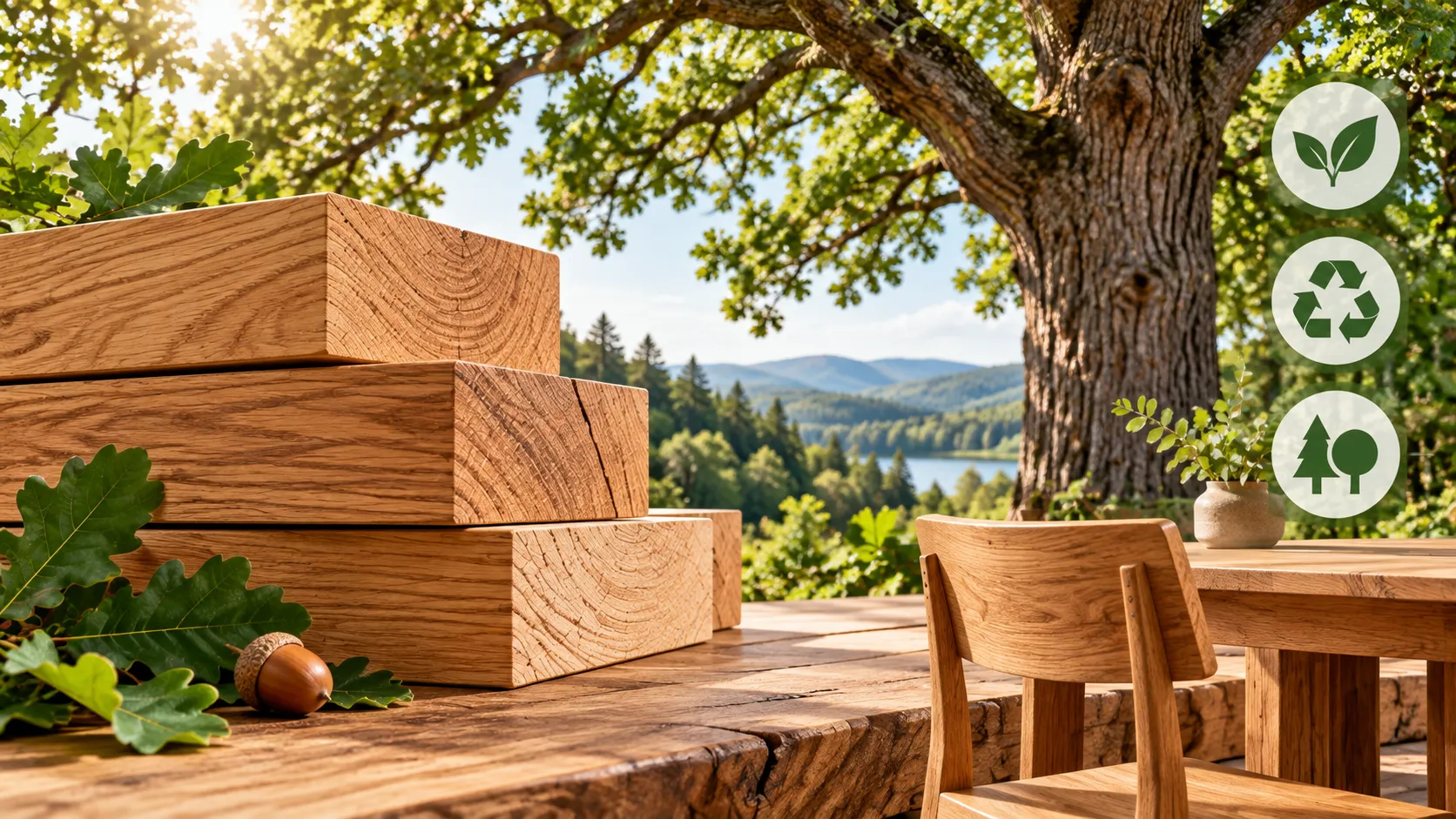
Oak has been a trusted material for centuries—think furniture that outlives its owners, flooring that withstands decades of foot traffic, and wine barrels that shape flavors for years. But as environmental awareness grows, so does a fair question: how sustainable is oak wood, really? The answer isn’t a simple yes or no. It depends on where the wood comes from, how the forest was managed, how far it traveled, and what happens to it at the end of its life. This guide breaks down the factors that determine oak’s true environmental impact, so you can make informed choices whether you’re buying furniture, flooring, or building materials.
Sustainability in wood production rests on several pillars: renewability, carbon balance, biodiversity, and social responsibility. A material is only truly sustainable if it can be produced indefinitely without depleting the resources it depends on—and without harming the ecosystems and communities connected to its production.
Here’s where a common confusion arises: renewable and sustainable are not the same thing. Oak is renewable—it grows back. But renewability alone doesn’t guarantee sustainability. If oak forests are clear-cut, replanted with monocultures, or harvested faster than they can regenerate, the practice isn’t sustainable even though the tree species itself is renewable. Sustainable oak comes from forests managed with long-term ecological health in mind, where harvesting rates stay within regeneration capacity and biodiversity is protected.
Several factors shape whether a given piece of oak is sustainable:
Keep these four factors in mind as we go deeper—they’ll come up again and again.
Not all oak is the same. The genus Quercus includes hundreds of species, but a handful dominate commercial use:
From a conservation standpoint, many oak species are classified as Least Concern by the IUCN, meaning they’re not currently at risk of extinction. However, some oak species in specific regions—particularly in parts of Mexico and Southeast Asia—face threats from habitat loss and climate change.
Why does species matter for sustainability? Because durability and growth rate create trade-offs. A slower-growing but highly durable white oak might last 100 years in a building, locking away carbon for a century. A faster-growing red oak can be replenished more quickly but may not last as long in demanding applications. Neither is inherently “better”—the right choice depends on the use case and the sourcing.
One of oak’s strongest environmental credentials is its ability to capture and store carbon. A growing oak tree absorbs roughly 10–25 kg of CO₂ per year, depending on its age, size, and local conditions. Younger, fast-growing trees tend to absorb more per year; older trees store more total carbon in their biomass.
When oak is harvested and turned into products, that carbon doesn’t disappear. About 50% of wood’s dry weight is carbon, and it stays locked in the material for as long as the product exists. A solid oak table, a timber-framed building, or oak flooring effectively becomes a carbon store—sometimes for generations. This is a significant advantage over materials like concrete and steel, which are energy-intensive to produce and don’t sequester carbon.
Life cycle assessment (LCA) data consistently shows that wood products have a much lower embodied carbon footprint than concrete or steel. Some studies suggest wood can have up to 75% less embodied carbon than these alternatives. Oak’s exact footprint depends on transport distance, processing methods, and end-of-life handling, but the carbon sequestered during growth gives it a meaningful head start.
Certification is one of the most reliable ways to verify that oak comes from responsibly managed forests. The two dominant schemes are:
Both schemes have limitations. Auditing isn’t perfect, and certification doesn’t guarantee zero environmental impact—it’s a framework for continuous improvement, not a seal of perfection.
Red flags to watch for include vague claims like “eco-friendly” or “natural” without third-party verification, suppliers who can’t disclose the country of origin, and regions with weak governance or known illegal logging problems. Illicit logging remains a serious issue in parts of Eastern Europe and Asia, and supply chains can be opaque.
Geographic sourcing also matters for transport emissions. Oak from a nearby region will generally have a lower carbon footprint than oak shipped across an ocean—though this varies depending on shipping efficiency and mode of transport. European and North American oak are often easier to trace and verify than wood from regions with weaker forestry oversight.
Carbon gets most of the attention, but oak’s environmental story goes further.
Biodiversity: Oak forests are ecological powerhouses. A single mature oak can support hundreds of species of insects, birds, and mammals. In Europe and North America, oak woodlands are considered biodiversity hotspots. How the forest is managed matters enormously—selective logging that leaves the forest structure intact supports far more biodiversity than clear-cutting, which can fragment habitats and disrupt ecosystems for decades.
Water and soil: Oak’s deep root systems help stabilize soil, reduce erosion, and improve water infiltration. Compared to fast-growing plantation species, oak’s water usage is moderate, though it varies by region and climate.
Waste reduction: The oak industry generates significant byproducts—sawdust, bark, and offcuts—that don’t go to waste. These are commonly used for biomass energy, mulch, and composite materials. At the end of a product’s life, solid oak is biodegradable and can often be recycled or repurposed, closing the loop in a way that synthetic materials rarely can.
How does oak stack up against other commonly promoted sustainable materials?
Bamboo: Grows extremely fast—often harvestable in 3–5 years—and requires minimal pesticides. However, many bamboo products are laminated with adhesives that can contain formaldehyde, and long-distance transport from Asia adds emissions. Bamboo is excellent for some applications but lacks oak’s structural durability.
Reclaimed wood: Often the most sustainable option because it requires no new logging and keeps existing carbon stored. Availability is limited, and quality varies, but for flooring and furniture, reclaimed oak is a standout choice.
Hemp: A fast-growing crop with low water needs, but it’s more commonly used for textiles and insulation than for structural or furniture applications.
Recycled composites: Materials made from recycled plastics and wood fibers can divert waste from landfills, but they may not be biodegradable and can have their own processing impacts.
When is oak the best choice? When you need durability, longevity, and a material that stores carbon for decades—especially for furniture, flooring, and structural elements. When might alternatives win? For short-lived or decorative items, fast-growing materials like bamboo or reclaimed options may have a lighter footprint.
If you want to make sure your oak purchase aligns with your environmental values, here’s what to do:
Oak forests face real threats. Climate change is bringing more frequent droughts, heat stress, and pest outbreaks—such as the processionary moth and oak decline syndromes in parts of Europe. Some regions may see oak ranges shift as temperatures rise.
On the policy front, the EU Deforestation Regulation (EUDR) is set to tighten requirements for wood products sold in Europe, requiring proof that they’re deforestation-free. Carbon credit markets and agroforestry systems—where oaks are integrated with crops or pasture—are emerging as tools to incentivize sustainable management.
Technological innovations are also helping: improved tracking systems for supply chains, breeding programs for climate-resilient oak varieties, and circular design approaches that plan for reuse from the start. These developments suggest that oak’s sustainability can improve—provided the will and the investment are there.
Is oak wood more sustainable than other woods like pine or bamboo?
Oak is generally sustainable when sourced responsibly, but its slow growth (80–150 years to maturity) means it requires careful management. Fast-growing woods like pine or bamboo can be more renewable in the short term, but oak’s durability and carbon storage over decades often make it a competitive choice. The best option depends on the specific application, sourcing, and end-of-life plan.
How can I tell if oak furniture or flooring is sustainably sourced?
Look for FSC or PEFC certification labels, ask for chain-of-custody documentation, and check if the retailer discloses the country of origin. Be wary of vague claims like “eco-friendly” without third-party verification. Reclaimed oak is also a highly sustainable option.
Does oak wood release carbon dioxide when it decomposes or burns?
Yes, when oak decomposes or burns, the stored carbon is released back into the atmosphere. However, if the wood is used in long-lasting products (e.g., furniture, buildings) and then reused or recycled, the carbon remains stored for decades. Sustainable forestry ensures new trees are planted to absorb equivalent CO₂, maintaining a balance.
What is the carbon footprint of oak compared to concrete or steel?
Oak typically has a much lower carbon footprint than concrete or steel. Studies show wood products can have 75% less embodied carbon than concrete and steel. Oak’s carbon footprint depends on transport distance, processing, and end-of-life, but it generally sequesters carbon during growth, offsetting emissions.
Are there any downsides to using oak wood for sustainability?
Potential downsides include slow growth (limiting rapid replenishment), risk of illegal logging in some regions, and biodiversity impacts if forests are managed poorly. Oak also requires energy for processing and transport. However, these can be mitigated through certification, responsible sourcing, and supporting reforestation.
Is reclaimed oak more sustainable than new oak?
Yes, reclaimed oak is often considered more sustainable because it diverts waste from landfills, reduces demand for newly harvested timber, and retains the carbon already stored in the wood. It also avoids the environmental impacts of logging and processing new wood, though it may have limited availability and higher cost.