Address
304 North Cardinal
St. Dorchester Center, MA 02124
Work Hours
Monday to Friday: 7AM - 7PM
Weekend: 10AM - 5PM
Address
304 North Cardinal
St. Dorchester Center, MA 02124
Work Hours
Monday to Friday: 7AM - 7PM
Weekend: 10AM - 5PM
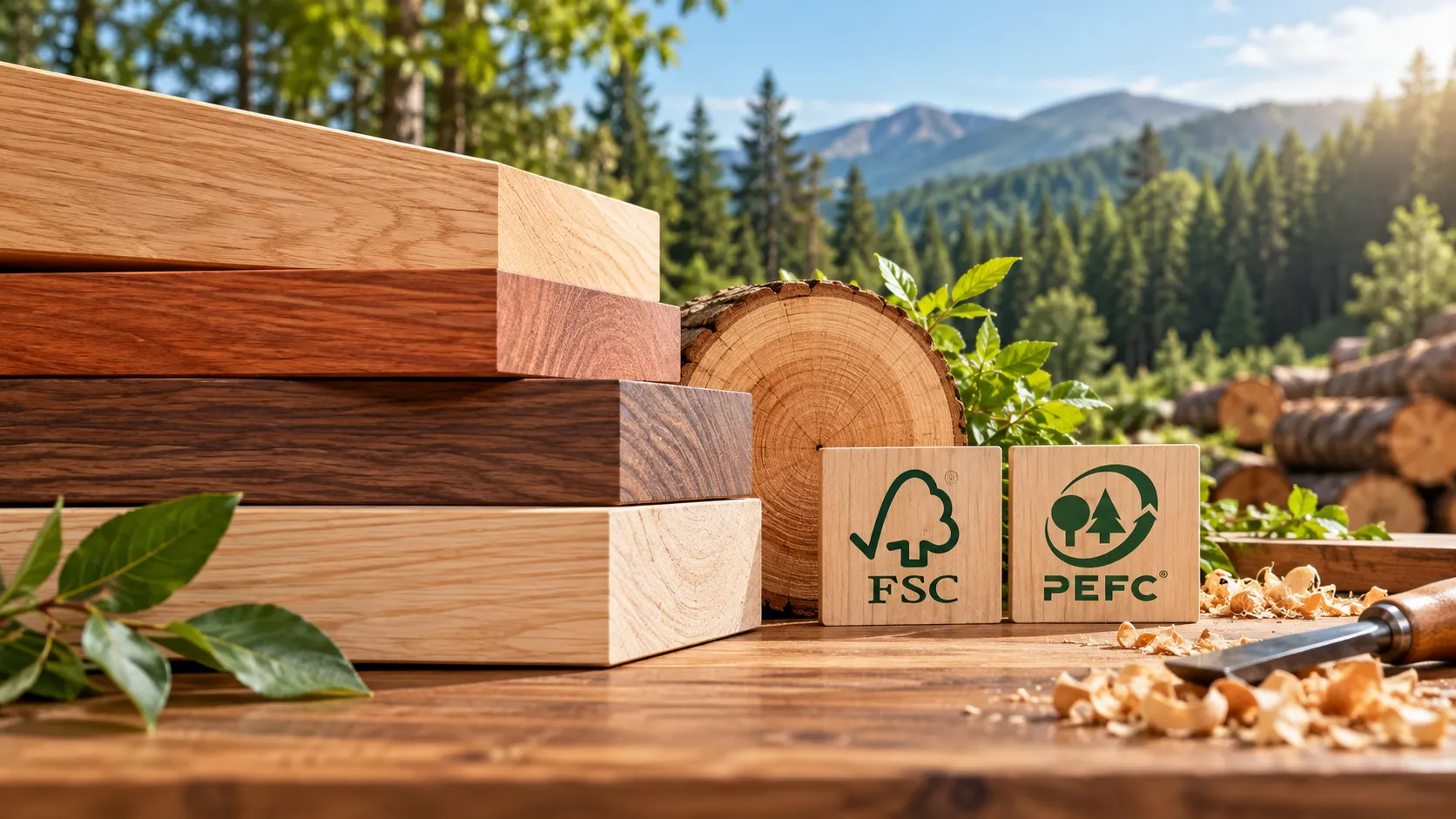
Walk into any lumber yard or browse any furniture site and you’ll see the same words plastered everywhere: eco-friendly, green, sustainable. Most of it is marketing. Some of it is genuine. The problem is that “sustainable wood” isn’t a single product you can point to — it’s a set of trade-offs between how fast a tree grows, where it comes from, how it’s processed, and what happens to it at the end of its life.
This guide cuts through the noise. Instead of ranking woods on a vague green scale, it breaks sustainability into criteria you can actually evaluate, compares the most credible species and materials side by side, and helps you match the right option to your project — whether that’s a dining table, a deck, or a house frame.
Wood is often called the most sustainable building material on earth, and there’s real evidence behind that. A responsibly managed forest pulls carbon out of the atmosphere and locks it into timber for decades. Wood’s carbon footprint can be up to 75% lower than steel or concrete for equivalent applications. But “wood” as a category isn’t automatically sustainable — the details decide everything.
Here are the criteria that actually matter.
Renewability and growth rate. A species that matures in 5–10 years (bamboo, some eucalyptus) can be harvested far more frequently than one that takes 80–100 years (many tropical hardwoods). Faster growth doesn’t automatically mean better — monoculture plantations can harm biodiversity — but it’s a major factor in how much pressure harvesting puts on forests.
Harvesting practices. Was the tree cut selectively, or was the area clear-cut? Is the forest replanted, and with what? Is the ecosystem’s structure preserved, or replaced with a single species? This is where certification bodies claim to add oversight — and where the real-world record is mixed.
Transport distance. A locally milled oak and a tropical hardwood shipped from halfway around the world can have very different footprints, even if both are certified. Shipping is carbon-efficient per ton-mile compared to trucking, but distances add up.
Processing and additives. Kiln-drying, adhesives, preservatives, and finishes all carry environmental and health costs. Engineered wood products frequently rely on formaldehyde-based binders — a detail that undermines an otherwise sustainable choice.
End-of-life. Solid wood can be refinished, reused, and eventually biodegrade. Particleboard and MDF typically can’t be refinished and often end up in landfill, where their adhesives can release VOCs.
Carbon storage. Every cubic meter of wood stores roughly a ton of CO₂. The longer a product stays in use — a chair that lasts 50 years versus one that lasts 5 — the longer that carbon stays locked away.
The two dominant certification systems are FSC (Forest Stewardship Council) and PEFC (Programme for the Endorsement of Forest Certification). Both operate chain-of-custody systems that track wood from forest to finished product, and both set standards for harvesting, replanting, and ecosystem protection.
FSC is generally considered the stricter of the two, with more emphasis on environmental and social criteria. PEFC is broader and often seen as more industry-friendly, partly because it endorses national schemes that vary in rigor.
Neither is flawless. Critics have pointed to certified operations with questionable practices, gaps in auditing, and the reality that a certificate guarantees a process, not a perfect outcome. The honest takeaway: certification is the strongest available signal, but it shouldn’t be your only one.
Greenwashing in the wood industry usually looks like one of these:
Reclaimed wood — salvaged from old barns, factories, warehouses, and demolished buildings — is arguably the most sustainable option available because it requires no new logging at all. Urban lumber takes this a step further: trees removed from city streets, parks, and yards for safety or development reasons get milled into usable material instead of chipped or landfilled.
Pros: Near-zero harvesting impact, unique character and patina, often denser and more stable than new-growth wood, and it diverts waste from landfills.
Cons: Supply is unpredictable, dimensions are limited, and old wood can carry lead paint, creosote, or other contaminants. Testing and proper cleaning are essential before use.
Bamboo isn’t technically a wood — it’s a grass — but it functions like one in flooring, furniture, and cutting boards. Its headline advantage is growth speed: 3–5 years to harvest versus 20–100+ years for most hardwoods.
Pros: Extremely renewable, hard when properly processed, and increasingly available with FSC certification.
Cons: Most bamboo products are laminated with adhesives that may contain formaldehyde. Monoculture bamboo plantations can reduce biodiversity compared to mixed forests. Durability varies widely by product quality — some bamboo flooring dents easily under heavy use.
Red Grandis is a plantation-grown eucalyptus from South America, valued as a fast-growing hardwood with FSC availability. It’s often marketed as a teak alternative because of its warm reddish tone and workability.
Pros: Grows quickly, machines and finishes well, and provides a genuine hardwood option at a mid-range price. FSC-certified supply is increasingly common.
Cons: Durability varies depending on how it’s grown and processed. It’s not as rot-resistant as teak or cedar in raw outdoor applications, so finishes or treatments matter.
These are the workhorses of responsibly managed temperate forests, particularly in North America and Europe. When sourced from well-managed forests with FSC or PEFC certification, they represent some of the most practical sustainable options available.
Maple: Hard, light-colored, excellent for furniture, flooring, and butcher blocks. Janka rating around 1,450.
Oak: Durable, abundant, and versatile. Red oak (Janka ~1,290) and white oak (Janka ~1,360) dominate furniture and flooring.
Beech: Hard, uniform, and widely used in furniture and plywood. Slightly less rot-resistant than oak.
Birch: Light, strong, and affordable. Frequently used in plywood and cabinetry, though birch plywood relies on adhesives that should be checked for formaldehyde content.
Softwoods dominate structural and outdoor applications, and several are genuinely sustainable when sourced well.
Pine: Fast-growing, widely available, affordable. Excellent for framing and interior work; not naturally rot-resistant.
Douglas Fir: Stronger than most softwoods, good for structural beams and framing. Sustainably managed supply is abundant in the Pacific Northwest.
Cedar: Naturally rot- and insect-resistant without chemical treatment. A top choice for decking, siding, and outdoor furniture.
Redwood: Similar rot resistance to cedar, with a distinctive color. Growth is slower, so sourcing matters more — look for certified second-growth.
Teak is beautiful and durable, but uncertified teak is often linked to deforestation in Southeast Asia — and even certified teak carries a long shipping footprint.
Two credible alternatives:
Cork is harvested from the bark of cork oak trees without cutting them down — the trees regenerate bark every 9 years. It’s genuinely renewable and excellent for flooring and insulation.
Engineered wood (plywood, MDF, particleboard) makes efficient use of timber and reduces waste. The catch is adhesives: urea-formaldehyde binders are common and off-gas VOCs. Look for no-added-formaldehyde (NAF) or low-VOC products.
| Material | Renewability | Durability | Typical Certifications | Best Uses | Cost Range |
|---|---|---|---|---|---|
| Reclaimed / urban lumber | Highest (no new logging) | High | N/A (verify contaminants) | Furniture, accents, flooring | $$–$$$ |
| Bamboo | Very high (3–5 yrs) | Medium–high | FSC | Flooring, furniture, boards | $–$$$ |
| Red Grandis Eucalyptus | High | Medium–high | FSC | Furniture, cabinetry, trim | $$ |
| Maple | Medium | High | FSC, PEFC | Furniture, flooring, boards | $$ |
| Oak | Medium | High | FSC, PEFC | Furniture, flooring, barrels | $$–$$$ |
| Beech / Birch | Medium | Medium–high | FSC, PEFC | Furniture, plywood, cabinetry | $–$$ |
| Pine | High | Medium | FSC, PEFC | Framing, interior | $ |
| Douglas Fir | Medium–high | Medium–high | FSC, PEFC | Structural, framing | $–$$ |
| Cedar | Medium | High (rot-resistant) | FSC, PEFC | Decking, siding, outdoor | $$ |
| Redwood | Low–medium | High (rot-resistant) | FSC | Decking, siding, outdoor | $$$ |
| Blue Gum Eucalyptus | High | High | FSC | Outdoor furniture, decking | $$ |
| Cork | Very high | Medium (flooring) | FSC | Flooring, insulation | $$–$$$ |
| Engineered wood (NAF) | High (efficient use) | Medium | FSC, CARB Phase 2 | Cabinetry, furniture cores | $–$$ |
Prioritize solid hardwood over veneered engineered wood where possible — it lasts longer, can be refinished, and typically avoids formaldehyde adhesives. Reclaimed or FSC-certified oak, maple, and walnut are strong choices.
Don’t overlook finishes: a sustainably sourced table coated in a high-VOC lacquer loses some of its eco-credential. Look for water-based, plant-oil, or wax finishes.
Durability matters more than almost anywhere else because flooring replacement is carbon-intensive. Check the Janka rating — higher means more dent-resistant.
The goal is rot resistance without toxic chemical treatment. Cedar, redwood, and Blue Gum eucalyptus all resist decay naturally. Avoid pressure-treated lumber containing chromated copper arsenate (CCA) and similar preservatives.
If the species isn’t naturally rot-resistant, use a non-toxic finish and be prepared to reapply it every few years.
Local softwoods — pine, Douglas fir, spruce — are usually the most sustainable choice for framing because they’re fast-growing, abundant, and travel short distances. Engineered structural products like cross-laminated timber (CLT) and glulam offer high strength with efficient timber use, though adhesive content varies by manufacturer.
Scraps, offcuts from local mills, reclaimed pallets (check for treatment stamps), and urban lumber suppliers are all budget-friendly sustainable sources. For small projects, using material that would otherwise be discarded often beats buying new — even certified new.
FSC sets global standards covering environmental, social, and economic criteria. It’s widely regarded as the stricter system, with detailed requirements around old-growth protection, Indigenous rights, and pesticide use.
PEFC endorses national certification schemes. It’s more flexible, which makes it more accessible to smallholders but also more variable in rigor.
Both operate chain-of-custody systems, meaning a product carrying their label should be traceable back through the supply chain. In practice, chain-of-custody can break down at the processor level, and audits are periodic rather than continuous.
Local sourcing, reclaimed materials, and community forest management — where forests are managed by local cooperatives or tribes — often deliver sustainability outcomes as strong as or stronger than certification alone, especially where certification overhead is prohibitive for small operations.
In the US, terms like “sustainable” and “eco-friendly” have no legal definition for wood products. The FTC’s Green Guides discourage unqualified claims but enforcement is limited.
In the EU, the situation is tightening. The EU Deforestation Regulation (EUDR) requires operators to prove that wood products placed on the EU market are deforestation-free and legally harvested, with geolocation data for the source plots. This is a meaningful step beyond certification.
A wood product’s footprint doesn’t stop at the sawmill. Three factors quietly shape whether a “sustainable” wood product actually delivers.
Urea-formaldehyde adhesives are common in plywood, MDF, and particleboard. They off-gas formaldehyde — a known respiratory irritant and carcinogen — for years. The CARB Phase 2 standard in California and similar regulations elsewhere set emission limits, but “compliant” isn’t the same as “none.”
Look for NAF (no-added-formaldehyde) or ULEF (ultra-low-emitting formaldehyde) labels if indoor air quality matters.
Water-based polyurethanes, linseed oil, tung oil, beeswax, and shellac all extend wood’s eco-credentials by avoiding the solvent load of conventional lacquers and varnishes. They generally require more frequent reapplication, but they’re safer to apply and to live with.
Solid wood can be refinished, reused, or biodegraded. Plywood and MDF usually can’t be refinished and often can’t be recycled, ending up in landfill where adhesives continue to off-gas. A solid oak table that lasts 60 years and gets refinished twice has a dramatically lower lifetime footprint than a particleboard table replaced every 5 years.
| Material | Adhesive Content | Refinishable | End-of-Life |
|---|---|---|---|
| Solid wood | None (unless glued joints) | Yes | Reuse, recycle, biodegrade |
| Plywood | Moderate–high | Limited | Often landfill |
| MDF | High | No | Landfill |
| Particleboard | High | No | Landfill |
The “buy local” instinct is usually right — but it’s not always as clear-cut as it seems.
Ocean shipping is remarkably carbon-efficient per ton-mile. A container of FSC-certified tropical hardwood shipped from South America may carry a lower transport footprint than the same volume of domestic wood trucked across a continent. Meanwhile, a poorly managed local forest can do more ecological damage than a well-managed certified forest abroad.
The real comparison is total impact: harvesting practices + transport + processing + lifespan. Transport is one variable, not the decisive one.
Blue Gum eucalyptus grown in California is fast-growing, often harvested as part of invasive species management, and travels short distances to West Coast buyers. Imported teak, even when FSC-certified, ships thousands of miles and is more vulnerable to illegal logging pressures in its native range.
For most West Coast outdoor projects, California Blue Gum wins on total footprint. For buyers in Southeast Asia, the calculation flips.
Cities remove thousands of trees every year for safety, disease, and development. Treecycling — milling those trees into lumber instead of chipping them — turns a waste stream into high-value material. The carbon savings are substantial, and the wood often has spectacular grain and character you won’t find in commercial lumber.
The EUDR is the biggest regulatory shift in wood sourcing in decades. It requires proof that products are deforestation-free and legally harvested, with geolocation data for source plots. Because the EU is a major market, the regulation is already reshaping supply chains well beyond Europe — exporters worldwide are adapting their documentation to comply.
Thermal modification heats wood to high temperatures in a low-oxygen environment, changing its cell structure to improve rot resistance and dimensional stability — without chemical preservatives. It’s an increasingly popular way to make non-durable species perform like naturally rot-resistant ones.
Cross-laminated timber (CLT), glulam, and dowel-laminated timber are enabling mid- and high-rise wood construction. They sequester carbon, speed up construction, and use lower-grade timber efficiently. Adhesive content varies; some systems use mechanical fasteners instead of glue entirely.
Follow FSC and PEFC announcements, check the IUCN Red List for endangered species, and track regulatory updates from the EUDR and the FTC’s Green Guides. For species-specific data, resources like the Wood Database and regional forestry associations are useful starting points.
What is the most sustainable wood for furniture?
Reclaimed or FSC-certified solid hardwoods like oak, maple, and walnut are the most sustainable for furniture because they avoid new logging, contain no formaldehyde-based adhesives, and last for generations. Avoid engineered wood with urea-formaldehyde binders unless labeled no-added-formaldehyde.
Is bamboo really more sustainable than hardwood?
Bamboo grows in 3–5 years versus 20–100+ years for hardwoods, making it highly renewable. However, many bamboo products use adhesives that may contain formaldehyde, and monoculture plantations can reduce biodiversity. Look for FSC-certified bamboo with low-VOC or no-added-formaldehyde binders for best sustainability.
How can I tell if wood is truly sustainable?
Check for FSC certification (or equivalent), ask about the species’ growth rate and origin, and prefer reclaimed or local wood when possible. Be wary of vague “eco-friendly” claims without proof. Certifications like FSC provide chain-of-custody assurance, though independent verification is still recommended.
What is the best sustainable wood for outdoor use?
Naturally rot-resistant species like cedar, redwood, and Blue Gum eucalyptus are excellent sustainable choices for outdoor furniture and decking. Avoid pressure-treated wood with toxic chemicals. If using imported wood, ensure it is FSC-certified and consider the transport footprint.
Is FSC-certified wood always sustainable?
FSC certification is widely respected but not flawless; some critics point to issues with certain certified operations. It remains the strongest available standard, but for maximum sustainability, combine FSC with local sourcing, reclaimed materials, and preference for species with low ecological impact.
Are reclaimed and recycled woods the best option?
Yes, reclaimed wood is generally the most sustainable choice because it requires no new logging, reduces waste, and often has unique character. However, reclaimed wood may contain lead paint or other contaminants; ensure it is properly tested and cleaned before use.
What are the least sustainable woods to avoid?
Avoid wood from endangered species (e.g., Brazilian rosewood, mahogany) and any uncertified tropical hardwoods linked to deforestation. Also avoid wood treated with toxic preservatives like chromated copper arsenate (CCA). Check the IUCN Red List and FSC listings for guidance.
How does wood compare to other building materials in sustainability?
Wood has a carbon footprint up to 75% lower than steel or concrete when sourced responsibly, and it stores carbon. However, sustainability depends on harvesting, transport, and processing. Using local, FSC-certified, or reclaimed wood maximizes the environmental advantage.