Address
304 North Cardinal
St. Dorchester Center, MA 02124
Work Hours
Monday to Friday: 7AM - 7PM
Weekend: 10AM - 5PM
Address
304 North Cardinal
St. Dorchester Center, MA 02124
Work Hours
Monday to Friday: 7AM - 7PM
Weekend: 10AM - 5PM
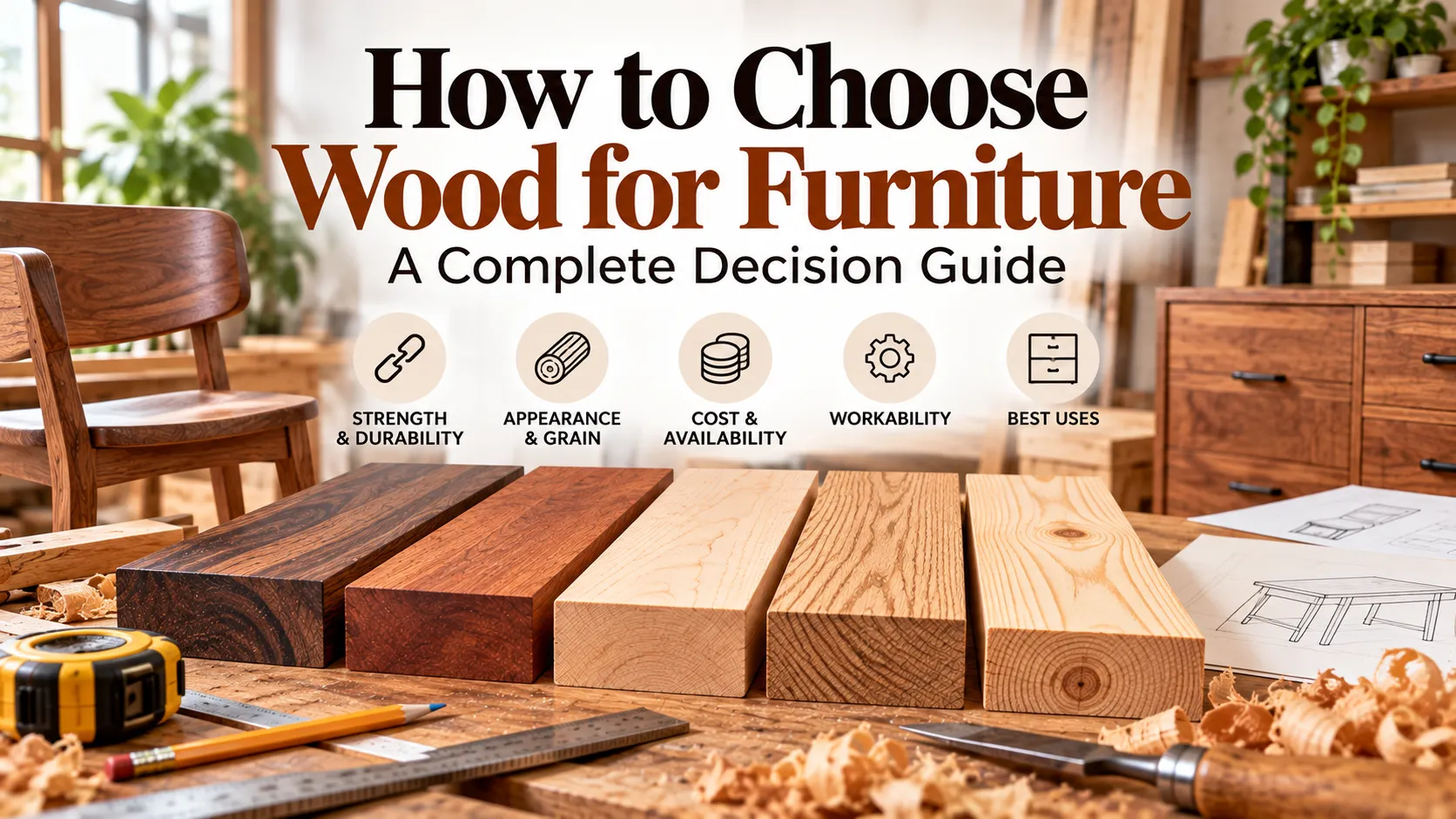
Walk into any lumber yard or browse a furniture catalog online, and you’ll quickly realize the options are overwhelming. Oak, walnut, maple, cherry, pine, teak, sapele — each one looks different, costs different, and behaves different under a saw or a screwdriver. Choosing the wrong wood can mean a wobbly table, a cracked panel, or a project that drains your budget before it’s half finished.
This guide walks you through a practical decision framework, compares 12 popular species at a glance, and breaks down how budget, climate, and skill level should shape your choice. By the end, you’ll know exactly how to choose wood for furniture without second-guessing every board you pick up.
Wood isn’t just a visual material. It’s a structural one, and its properties determine how your furniture performs over years or decades.
Durability. Density and grain structure dictate how well a piece resists dents, scratches, and warping. A dining table made from soft pine will show every fork mark; the same design in hard maple can handle daily abuse for a generation.
Cost. Two boards of the same dimensions can differ in price by a factor of ten. Walnut might run you several times what poplar costs for the same board foot, and that gap compounds fast on a large project.
Appearance. Color, grain pattern, and how the wood takes finish vary enormously. Some species darken beautifully with age; others blotch if you look at them wrong during staining.
Resale value. Solid hardwood furniture holds value in a way that particle board never will. If you’re building something you intend to pass down or sell, the species you choose directly affects what it’s worth later.
The most common mistake beginners make is picking wood based on looks alone. A gorgeous open-grained ash might be perfect for a bookshelf but a disaster for a small carved detail. Aesthetically driven choices ignore workability, movement, and long-term stability — the exact factors that determine whether your project succeeds.
Before diving into specifics, it helps to understand the three broad categories:
Rather than starting with species, start with your project. Work through these six steps in order.
A coffee table, a dining chair, a wardrobe, and a garden bench all place different demands on wood.
Write down how the piece will actually be used before you look at a single price tag.
Wood pricing is usually quoted per board foot — a volume measure equal to 144 cubic inches. Roughly:
Always budget 20–30% extra for waste, milling, and finishing supplies. The board you buy is not the board you use.
Hardness and grain structure affect how forgiving a wood is. Soft, straight-grained species like pine and poplar are easy to cut, sand, and shape with basic tools. Dense, interlocked species like hickory or rosewood demand sharp blades, patience, and often more powerful equipment.
Be honest about your setup. If you’re working with a circular saw and a random orbital sander, don’t pick a species famous for tear-out.
Wood moves. It expands and contracts with moisture, and the degree varies by species. In a humid coastal climate, you want species with good dimensional stability and, ideally, natural moisture resistance. In arid regions, kiln-dried woods that are less prone to checking are safer.
We’ll cover this in more depth later, but keep it in mind as a filter.
Now — and only now — think about looks.
Bring home a sample board or two and view them in your actual lighting before committing.
Ask where the wood comes from and how it was harvested. Certification, reclaimed stock, and local sourcing all reduce environmental impact and often improve quality consistency. The final section of this guide covers this in detail.
Use this as a quick-reference before you dive into deeper research on any single species. The Janka hardness number reflects the force required to embed a steel ball into the wood surface — higher means harder.
| Species | Janka Hardness (lbf) | Cost Tier | Workability | Best Use | Color / Grain Notes |
|---|---|---|---|---|---|
| Oak (red/white) | ~1,290–1,360 | Mid | Good, though open grain | Tables, cabinets, flooring | Golden to pale brown, pronounced grain |
| Walnut | ~1,010 | Premium | Excellent, machines well | Fine furniture, tables | Rich brown, straight to wavy grain |
| Maple (hard) | ~1,450 | Mid | Good but can burn when cut | Cutting boards, tables, cabinets | Pale cream, subtle grain |
| Cherry | ~950 | Mid | Excellent | Cabinets, desks, heirloom pieces | Warm reddish-brown, darkens with age |
| Pine | ~380–600 | Budget | Very easy | Painted furniture, rustic pieces | Pale yellow, knots common |
| Mahogany | ~800–900 | Premium | Excellent | Traditional furniture, veneers | Deep reddish-brown, fine grain |
| Teak | ~1,000–1,155 | Premium | Moderate, oily | Outdoor furniture, boats | Golden brown, straight grain |
| Ash | ~1,320 | Mid | Good, similar to oak | Tool handles, chairs, tables | Light, open grain |
| Hickory | ~1,820 | Mid | Difficult, tear-out prone | Heavy-use furniture, tools | Strong contrasting grain |
| Cedar | ~350–900 | Budget–Mid | Easy | Outdoor furniture, chests | Reddish-brown, aromatic |
| Poplar | ~540 | Budget | Very easy | Painted furniture, drawers | Pale green-brown, subtle grain |
| Sapele | ~1,410 | Mid–Premium | Good, interlocked grain | Furniture, cabinetry, trim | Mahogany-like, ribbon stripe |
Spending more doesn’t automatically mean better furniture, but it does buy you options. Here’s how the tiers shake out.
Entry-level: pine, poplar, aspen. These are inexpensive, widely available, and easy to work. Pine is the classic starter wood, though its softness means dents and dings accumulate quickly. Poplar takes paint beautifully but looks plain unfinished. Aspen is light and uniform. These woods are ideal for painted furniture, prototypes, shop jigs, and pieces where budget matters more than longevity.
Mid-range: oak, cherry, birch, ash. This is the sweet spot for most projects. Oak is durable and forgiving, with strong grain character. Cherry offers a premium look at a reasonable price and ages beautifully. Ash is tough and takes stains well. Birch is a solid maple alternative at lower cost. For dining tables, bookshelves, and everyday furniture, this tier delivers the best balance of cost and performance.
Premium: walnut, mahogany, teak, rosewood. When you’re building an heirloom, a statement piece, or outdoor furniture meant to survive the elements, premium species earn their price. Walnut’s deep color and workability justify the cost on fine furniture. Teak’s natural oils make it a benchmark for outdoor use. Mahogany remains a classic for traditional work. Reserve these for projects where the wood itself is part of the point.
The hidden cost of cheap wood. A $3 board foot price can become expensive fast. Cheap woods often need more filling, sanding, and sealing. Soft species require more frequent refinishing. Low-grade boards waste more material during milling. And a piece that fails in two years costs you the original build plus the rebuild. The cheapest wood is rarely the cheapest furniture.
Wood is hygroscopic — it absorbs and releases moisture from the air. This causes expansion and contraction across the grain, and the amount varies by species.
In humid climates, boards swell. In dry climates, they shrink and can crack if dried too fast or finished improperly. Indoor spaces are usually more stable than outdoor, but a humid basement or an arid desert home still demands consideration.
Best species for high-humidity areas: teak, cedar, and white oak all offer natural moisture and rot resistance. They’re the go-to choices for bathrooms, kitchens, and coastal homes.
Best species for dry climates: maple, cherry, and walnut tend to be more dimensionally stable once properly kiln-dried. They handle low humidity without excessive checking.
Outdoor furniture considerations. Rot resistance matters most here. Teak, cedar, and white oak are the top picks, followed closely by mahogany and some tropical species. Finish matters as much as species — regular oiling or sealing dramatically extends lifespan. Even a rot-resistant wood will degrade if left untreated for years.
Whatever your climate, acclimate your wood to your shop or home before building. Stack it with spacers, let it sit for a week or more, and check moisture content with a meter if you have one.
Some species fight back. Others cooperate. Matching wood to skill level prevents a lot of frustration.
Beginner-friendly: pine, poplar, cherry. These cut cleanly with basic tools, sand easily, and accept finish without much fuss. Pine is affordable and everywhere. Poplar is uniform and forgiving. Cherry is a step up in appearance while staying easy to machine.
Intermediate: oak, maple, ash. These require sharp tools and a bit more patience. Oak’s open grain can tear out if you cut against it. Maple burns easily if your blade is dull. Ash is similar to oak. All three reward good technique and punish sloppiness.
Challenging: hickory, rosewood, teak. Hickory is dense and prone to tear-out, especially around knots. Rosewood is hard and oily, which can interfere with glue and finish adhesion. Teak’s natural oils are great outdoors but tricky indoors — they resist finishes and dull blades quickly.
Tips for working with difficult woods: keep blades and bits sharp, take lighter passes, use a zero-clearance insert to reduce tear-out, and wipe oily woods with solvent before gluing. Slow down. These woods reward patience more than force.
A few persistent myths trip up beginners year after year.
Myth: Hardwood is always harder than softwood. Botanical classification has nothing to do with actual hardness. Balsa is a hardwood and among the softest woods on earth. Yew is a softwood and harder than many hardwoods. Judge by the Janka scale, not the category.
Myth: More expensive wood always lasts longer. Price reflects scarcity, color, and workability as much as durability. A well-built oak table will outlast a poorly constructed walnut one every time.
Myth: Solid wood never warps or cracks. All wood moves. Improper drying, poor finishing, or exposure to extreme humidity can warp or crack any species, no matter how premium.
Myth: Engineered wood is always inferior. High-quality plywood outperforms low-grade solid wood in stability and sometimes in strength. The key is the quality of the panel, not its category. Cheap particle board is a different story entirely.
The right finish protects your furniture and brings out the grain without causing problems.
Oil vs lacquer vs polyurethane. Oil finishes (tung, linseed) penetrate the wood and give a natural look but require more frequent reapplication. Lacquer dries fast and looks great on fine furniture but needs spray equipment for best results. Polyurethane is durable, easy to apply with a brush, and ideal for high-traffic surfaces like tabletops.
Blotching risk. Cherry, maple, and pine are notorious for blotching when stained. A pre-stain conditioner or a gel stain dramatically reduces the problem. Always test on scrap first.
Maintenance schedule. Indoor furniture typically needs refinishing every 5–15 years depending on use. Outdoor furniture benefits from annual oiling or sealing. Wipe up spills quickly, avoid harsh cleaners, and keep pieces out of direct sun when possible.
Repair and refinishing. Hard, dense woods like oak and maple refinish well and can be sanded multiple times. Softer woods like pine are more forgiving but show wear sooner. Engineered panels can usually only be refinished once, if at all.
Wood is a renewable resource — but only when it’s managed well.
FSC certification. The Forest Stewardship Council label indicates the wood comes from responsibly managed forests. It’s one of the most widely recognized standards and a good shorthand for responsible sourcing.
Reclaimed and salvaged wood. Old barns, factories, and warehouses yield beautiful, often denser wood with unique character. Reclaimed stock also avoids new harvesting entirely.
Local vs imported. Local wood has a smaller carbon footprint and is often cheaper, but availability depends on your region. Imported exotics offer colors and properties you can’t get locally — just weigh that against shipping impact.
Questions to ask your supplier: Where was this wood harvested? Is it certified? How was it dried? Can you tell me the moisture content? A good supplier answers these without hesitation.
What is the best wood for furniture for beginners?
Pine, poplar, and cherry are widely recommended for beginners because they are relatively soft, easy to cut and sand, and accept finishes well. Pine is affordable and available at most hardware stores, while cherry offers a premium look with good workability.
Is hardwood always better than softwood for furniture?
Not necessarily. While hardwoods are generally denser and more durable, some softwoods like cedar and yew are harder than certain hardwoods. The best choice depends on the specific project, budget, and environment. Softwoods can be excellent for painted furniture or outdoor pieces.
How do I choose between solid wood and engineered wood for furniture?
Solid wood is more durable, repairable, and adds value over time. Engineered wood (plywood, MDF, particle board) is cheaper and more stable in humidity but less durable and cannot be refinished multiple times. Choose solid wood for heirloom pieces and engineered wood for budget or temporary furniture.
What is the Janka hardness scale and why does it matter?
The Janka hardness scale measures the force required to embed a steel ball into wood. Higher numbers mean harder wood, which resists dents and wear better. It’s a useful guide for choosing wood for high-traffic furniture like dining tables and floors.
Which wood is best for outdoor furniture?
Teak, cedar, and white oak are top choices for outdoor furniture due to their natural rot resistance and durability. They can withstand moisture and temperature changes better than most other species. Regular oiling or sealing extends their life.
How much does furniture wood cost per board foot?
Prices vary widely: pine and poplar range from $2–$5 per board foot, oak and cherry from $5–$10, and premium woods like walnut and mahogany from $10–$20+. Exotic species can exceed $30. Always factor in waste and finishing costs.