Address
304 North Cardinal
St. Dorchester Center, MA 02124
Work Hours
Monday to Friday: 7AM - 7PM
Weekend: 10AM - 5PM
Address
304 North Cardinal
St. Dorchester Center, MA 02124
Work Hours
Monday to Friday: 7AM - 7PM
Weekend: 10AM - 5PM
How to choose a solid wood coffee table: what counts as solid wood, how to spot veneer and MDF, the best woods, sizing rules, typical costs and how to care for it.
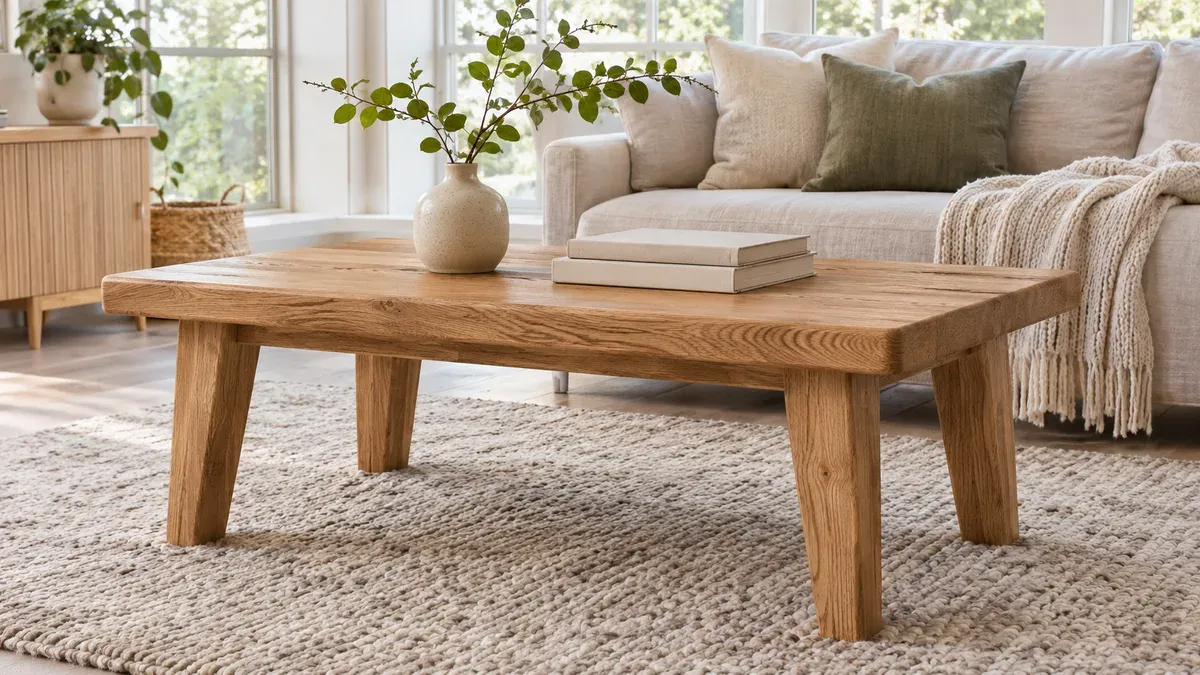
Quick answer: A solid wood coffee table is made entirely from real lumber, with no particleboard, MDF or thin veneer over a core. It costs more, but it can be sanded and refinished, handles daily wear well and can last for decades. Good choices include oak, maple, walnut, cherry, hickory and acacia, while rubberwood, mango and pine are budget-friendly. To confirm it is truly solid, look for a named wood species in the listing and check that the grain on the top continues over the edges and shows end grain on the ends. Size it at about two-thirds the length of your sofa, 16 to 18 inches high and 12 to 18 inches from the seat.
Table of contents
In furniture listings, “solid wood” should mean that every visible part, and ideally the whole structure, is made from pieces of real lumber. Wide tops are usually several boards glued edge to edge, which is normal and still solid wood. What does not count:
For most people who plan to keep a table for many years, yes. A coffee table takes more abuse than almost any other piece in the living room: hot mugs, feet, toys, laptops and moving day. Solid wood handles that well, and when it finally looks worn, you can sand and refinish it instead of throwing it away.
| Choose solid wood if you… | A cheaper table may be fine if you… |
|---|---|
| Want a table that lasts 10+ years | Move often or rent short term |
| Have kids, pets or heavy daily use | Need something light and easy to carry |
| Like the option to refinish it later | Want a specific modern look on a tight budget |
| Prefer natural materials and real grain | Plan to replace it in a few years |
| Solid wood | Wood veneer | MDF / particleboard | |
|---|---|---|---|
| What it is | Real lumber throughout | Thin real wood over a core | Pressed wood fibers or chips with resin |
| Durability | High | Good if the core is plywood | Lower; edges and corners chip |
| Water damage | Can usually be repaired | Veneer can lift or bubble | Swells and crumbles when wet |
| Can be refinished | Yes, many times | Lightly, once at most | No |
| Weight | Heavy | Medium to heavy | Medium to heavy |
| Price | $$–$$$$ | $$–$$$ | $–$$ |
| Typical lifespan | Decades with care | Many years | A few years with heavy use |
Good veneer furniture on a plywood core can be excellent, and some high-end designs use veneer on purpose. The real concern is particleboard or MDF sold with wording that suggests solid wood.
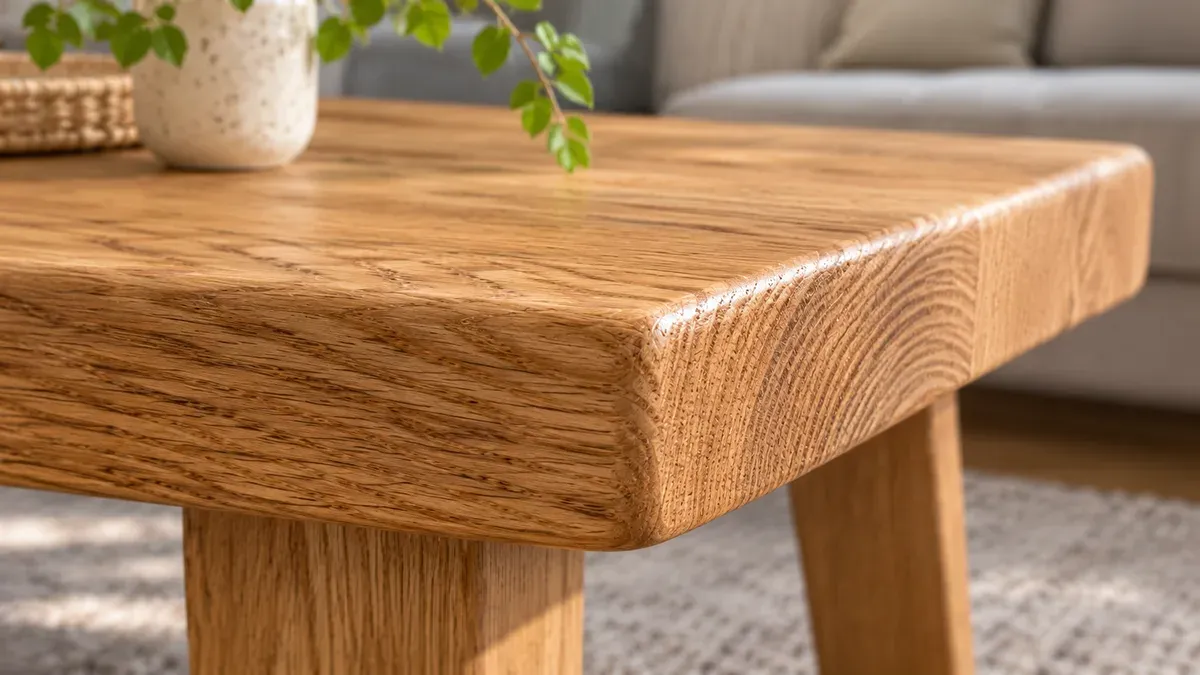
For more clues on telling woods apart, see our guide on how to identify different wood types.
A high price does not guarantee solid wood. Many buyers are surprised to find that tables costing $1,000 or more at well-known retailers use veneer over particleboard or MDF in some parts. Always read the materials line, even on expensive furniture.
Hardness matters for a coffee table because the top takes dents from mugs, toys and feet. Hardness is measured on the Janka scale; higher numbers resist dents better. Wood properties vary by species and even by board (USDA Forest Products Laboratory, Wood Handbook).
| Wood | Typical Janka hardness (lbf) | Look | Best for |
|---|---|---|---|
| Hickory | About 1,800 | Bold, rustic grain | Very busy homes, farmhouse style |
| Hard maple | 1,450 | Pale, smooth, subtle grain | Modern and Scandinavian rooms |
| White oak | About 1,350 | Light to mid brown, strong grain | Almost any style; very durable |
| Red oak | About 1,300 | Warm, pronounced grain | Traditional and farmhouse rooms |
| Acacia | About 1,150–1,800 | Golden to dark, dramatic grain | Good value with bold character |
| Walnut | 1,010 | Rich chocolate brown | Mid-century and luxury looks |
| Rubberwood | About 1,000 | Pale, even grain, often stained | Budget-friendly solid wood |
| Cherry | 995 | Warm reddish brown that darkens | Classic and traditional rooms |
| Pine | Soft (often well under 900) | Knotty, light | Rustic look; dents easily |
Janka figures are typical published values and vary between sources. Walnut and cherry are softer than oak or maple, so they show dents sooner, but many people love how they age. For a deeper comparison, read which wood is strong for furniture, the best lumber for indoor furniture and how to choose wood for furniture.
Yes. Rubberwood comes from the rubber tree (Hevea brasiliensis), which is grown on plantations for latex. When the trees stop producing latex, they are harvested for lumber, which makes rubberwood an efficient use of trees that would otherwise be cleared. It is a real hardwood of moderate hardness, similar to cherry or walnut on the Janka scale, with a pale, even grain that takes stain well.
Two things to check: rubberwood is often made of short pieces finger-jointed together, which is normal, and some listings say “rubberwood frame” while the top is engineered wood. Ask what the top is made from.
| Measurement | Guideline |
|---|---|
| Length | About two-thirds of your sofa length (an 84 in sofa suits a table of about 56 in) |
| Height | 16–18 in, ideally 1–2 in lower than the sofa seat |
| Distance from sofa | About 12–18 in of clear space between the sofa and the table |
| Walkways | Leave about 30 in or more for main walking paths around the table |
These rules of thumb are widely used by designers (Bob Vila). In a small living room, a round or oval table is easier to walk around and has no sharp corners. With a sectional, a square or round table often fits the L-shape best.
Prices vary widely by species, size and maker. As a rough guide based on current US retail listings:
| Price range | What you typically get |
|---|---|
| About $150–$400 | Solid pine, rubberwood, mango or acacia; mass-produced, often stained |
| About $400–$1,000 | Solid oak, acacia or ash from larger brands; better joinery and finishes |
| $1,000 and up | Handmade or Amish-built walnut, cherry, white oak or live-edge tables; custom sizes |
If a listing calls a large table “solid wood” but costs much less than this, check the materials line carefully.
One of the most common complaints from new owners is a “solid wood” table that swelled, lifted or got white rings after a spill. The finish, not just the wood, decides how well a coffee table handles water.
| Finish | Water resistance | Good to know |
|---|---|---|
| Oil or hardwax oil | Low to moderate | Natural look and easy spot repairs, but spills must be wiped quickly; re-oil regularly |
| Wax | Low | Soft sheen; water and heat leave marks easily |
| Shellac | Low | Traditional on antiques; water and alcohol damage it |
| Lacquer | Moderate to good | Common on factory furniture; can be repaired by a refinisher |
| Polyurethane or varnish | Good | Hard, protective film; best for heavy everyday use |
| Conversion varnish or catalyzed lacquer | Very good | Used on higher-end factory furniture; very durable but harder to repair at home |
For a family with kids or pets, or if drinks often sit on the table overnight, choose a hard film finish such as polyurethane, varnish or a catalyzed finish, and still use coasters. If a listing does not name the finish, ask the seller before you buy.
Wherever you shop, use the checks above: named species, grain that wraps the edges, end grain on the ends and a realistic weight.
Solid wood naturally expands and contracts as indoor humidity changes. A well-made table is built for this, so small seasonal movement is normal. Problems happen when the wood dries out or gets wet quickly:
For more ways to protect wood, read how to make wood more durable.
Solid wood is not the only good option. If you rent, move often or want a specific look for less, a table that combines wood with engineered materials can make more sense. Just buy it knowing what it is. Our coffee tables collection lists the construction on every product page, for example:
Whatever you choose, the same care rules apply: coasters, quick spill cleanup and no standing water. Engineered wood is especially sensitive to moisture at the edges.
If you want a table that lasts for many years and can be refinished, yes. If you move often or need a temporary table, a well-made engineered wood table can be a better value.
Hickory, hard maple and white oak are among the hardest and most dent-resistant common choices. Walnut and cherry are softer but age beautifully.
Check that the grain continues over the edges, look for end grain on the short ends, inspect the underside, and look for a named species in the listing.
No. “Walnut finish” describes the color. The table may be made of another wood or of engineered wood. Look for “solid walnut” if you want the real species.
Yes, for the price. Rubberwood is a real hardwood with moderate hardness. It dents more easily than oak or maple but is an affordable way to get solid wood.
Yes. Acacia is dense, attractive and usually affordable. Its grain and quality vary by species and maker, so check the build quality.
Aim for about two-thirds of your sofa length, 16 to 18 inches high and 12 to 18 inches from the sofa seat.
Usually because the air is very dry or the table sits near a heat source. Keep humidity moderate and move the table away from vents and radiators.
White rings in the finish often respond to gentle heat or a mild polish. Dark rings mean water reached the wood and may need sanding and refinishing.
It is best not to. Heat and moisture can mark the finish. Use coasters and trivets to protect it.
It depends on what you expect. Good veneer over plywood can be high quality, but particleboard hidden under veneer at that price is a fair reason to look elsewhere. Read the materials list for every part before you buy.
Hard film finishes such as polyurethane, varnish or catalyzed lacquer resist water best. Oil and wax finishes look natural but need quick spill cleanup and regular maintenance.
They are useful if you eat or work on a laptop from the sofa, and the hidden storage helps small spaces. Check the lift mechanism, the weight limit and what the top is made of, since many are engineered wood. Our 39 in lift-top coffee table is one example, built from particleboard.