Address
304 North Cardinal
St. Dorchester Center, MA 02124
Work Hours
Monday to Friday: 7AM - 7PM
Weekend: 10AM - 5PM
Address
304 North Cardinal
St. Dorchester Center, MA 02124
Work Hours
Monday to Friday: 7AM - 7PM
Weekend: 10AM - 5PM
Yes, acacia makes a good cutting board when it is well made. Learn the pros and cons, how it compares with maple and walnut, and how to fix common acacia board problems.
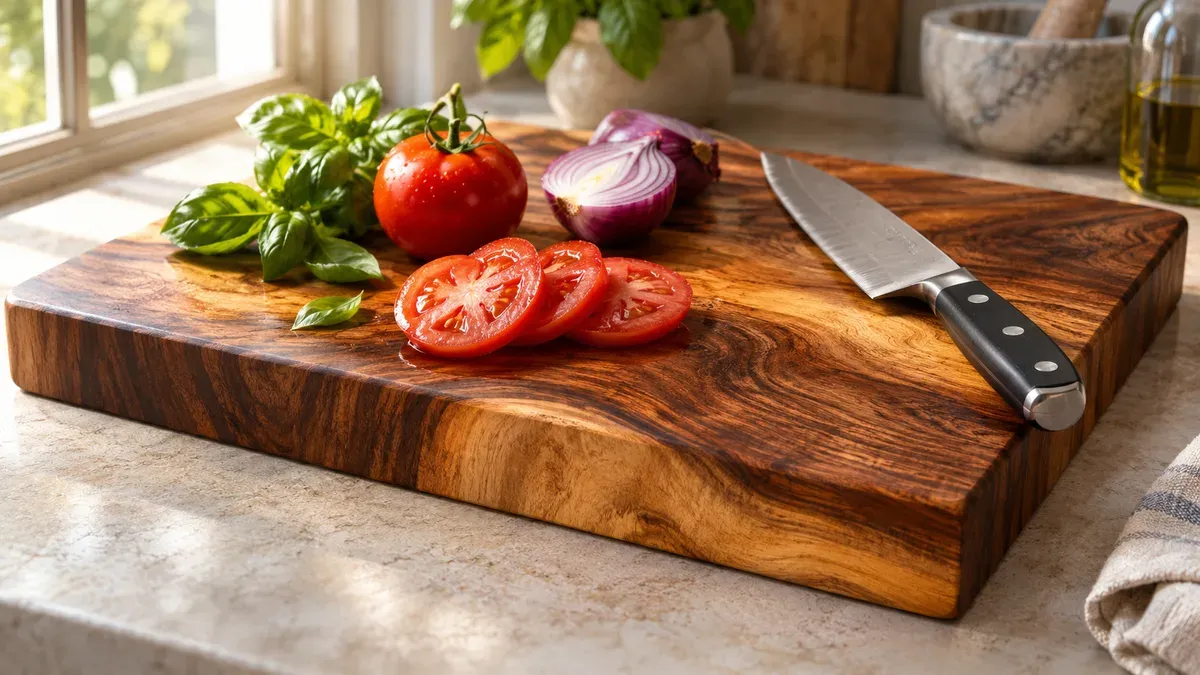
Quick answer: Yes, acacia wood is good for cutting boards when the board is well made. It is a dense, oily hardwood that resists moisture, looks striking and usually costs less than maple or walnut. The trade-offs are real, though: acacia is a little harder on knives than maple, knife marks show clearly on its contrasting grain, and quality varies a lot because “acacia” covers hundreds of species and many mass-produced boards. Choose a thick, tightly glued board with a food-safe oil finish and oil it regularly, and it will serve you for years.
Table of contents
| Question | Short answer |
|---|---|
| Is acacia food safe? | Yes. Solid hardwood boards, acacia included, are a normal choice for food prep when cleaned and dried properly. |
| Is it durable? | Yes, if it is thick and well glued. Thin, cheaply glued boards are the ones that crack and warp. |
| Is it knife friendly? | Good, but slightly harder on edges than maple, walnut or cherry. End grain is kinder than edge grain. |
| Does it need oiling? | Yes. Plan on oiling about once a month, more often when it looks pale or dry. |
| Does it show knife marks? | More than most woods. The light inner wood shows through the darker oiled surface. |
| Is it good value? | Usually. Acacia boards often cost less than maple or walnut of the same size. |
Acacia is not one wood. It is a large genus of trees and shrubs with more than 1,000 species. Most acacia kitchenware sold today comes from fast-growing plantation trees in Southeast Asia, but the label rarely tells you which species you are getting. That matters, because hardness, color and stability vary from species to species and even from board to board.
This is the main reason opinions about acacia are so split. On cutting board forums you will find woodworkers who call acacia “not a desirable wood” next to people who have used the same acacia board daily for years. Both can be right. The wood itself is capable; the problem is that a lot of acacia boards are made quickly from small, thin strips with little quality control.
One more source of confusion: in Europe, “acacia” is often used for black locust (Robinia pseudoacacia), sometimes called false acacia. It is a different tree with different properties, so reviews from European sellers may not describe the same wood as a board from Southeast Asia.
A little harder than the classic choices, but not dramatically so. Hardness is measured on the Janka scale, which records the force needed to press a steel ball into the wood. The acacia species commonly sold for kitchenware typically fall somewhere between about 1,150 and 1,800 lbf, while hard maple, the industry standard, is about 1,450 lbf.
| Wood | Typical Janka hardness (lbf) | Knife friendliness |
|---|---|---|
| Cherry | 995 | Excellent |
| Walnut | 1,010 | Excellent |
| Beech | About 1,300 | Very good |
| Hard maple | 1,450 | Very good |
| Acacia (common species) | About 1,150–1,800 | Good |
| Bamboo (a grass) | About 1,380, plus hard glue lines | Fair |
Janka figures are typical published values and vary between sources, species and individual boards. Two things matter more than the number:
| Acacia | Hard maple | Walnut | |
|---|---|---|---|
| Hardness (lbf) | About 1,150–1,800 | 1,450 | 1,010 |
| Knife friendliness | Good | Very good | Excellent |
| Moisture resistance | Good (natural oils) | Good (tight, closed grain) | Good |
| Shows knife marks | Clearly | Moderately | Less (dark color hides marks) |
| Stains | Hides some stains | Shows stains on pale wood | Hides stains well |
| Typical price | $ | $$ | $$$ |
| Best for | Budget everyday and serving boards | Heavy daily prep | Premium boards and gifts |
Is a walnut or maple board a real upgrade? For most home cooks the bigger upgrade is build quality, not the species. A thick, well-made acacia board will outlast a thin, poorly glued walnut one. If you want the full comparison, read our guide to the best wood for cutting boards or our closer look at the walnut cutting board.
Most worried questions about acacia boards come down to five situations. Here is what is happening in each one and what to do.
This is normal for a very dry board, and especially for end grain boards, which drink oil through the open ends of the fibers. Some boards also leave the factory with a light coating that makes water bead at first. As that coating wears off, the bare wood starts absorbing much more oil.
You did not ruin it. Oil deepens the color of almost every wood, and acacia changes more than most because of its rich natural pigments. The color often softens a little as the oil settles over a few days, but an oiled board will not return to its pale, unfinished look. If you prefer a lighter board, use thin coats and wipe them off well.
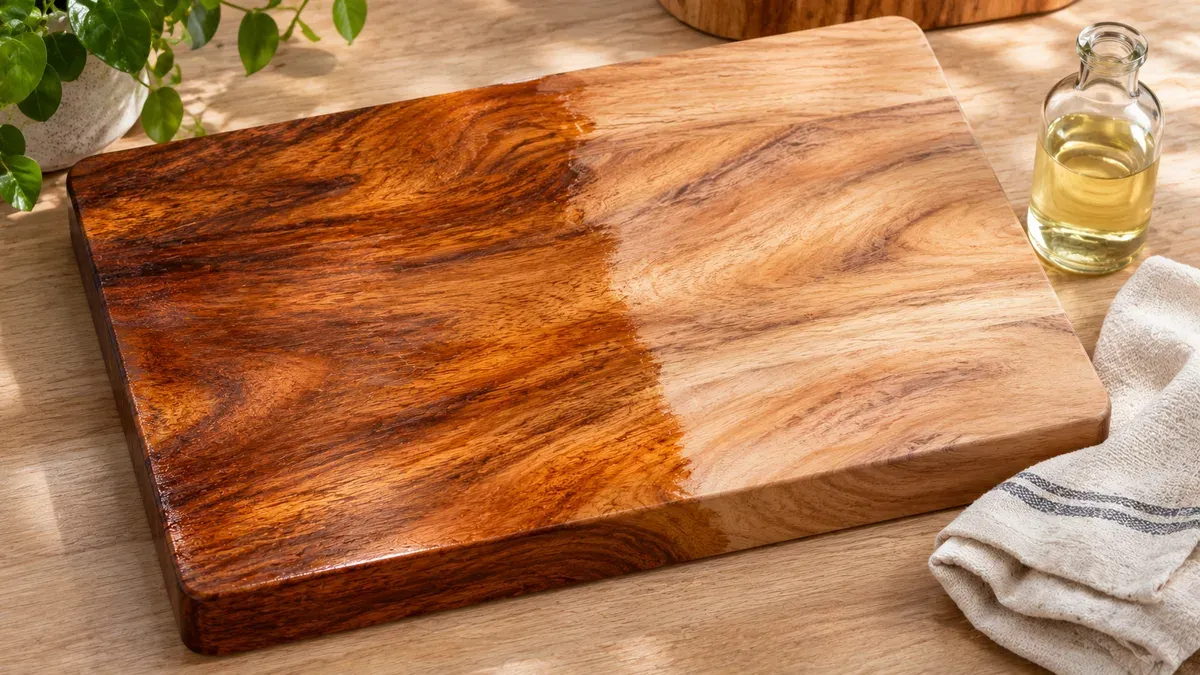
Knife marks appear on every wooden board, but acacia shows them clearly because the fresh, lighter wood under each cut contrasts with the darker oiled surface. Serrated bread knives leave the most obvious marks. The scratches are cosmetic. When deep grooves start to collect food, sand the surface lightly with 180 and then 220 grit sandpaper and re-oil it.
When wood gets wet for the first time, loose surface fibers swell and lift. This is called raised grain, and it happens when a manufacturer skips the step of raising and sanding the grain before finishing. To fix it, wet the board, let it dry completely, sand it lightly with 220 grit, wipe off the dust and oil it. If fibers keep coming off after that, the board is poorly made and is worth returning.
Cracks and warping usually come from soaking the board, running it through the dishwasher, drying it flat on one side or never oiling it. Thin boards (well under an inch thick) are the most vulnerable. A small surface check can be sanded and oiled, but a crack along a glue line usually means the board should be replaced.
Because the species is rarely disclosed, judge the board itself. Use this checklist in a store or when reading product photos and reviews:
Acacia is sometimes sold in a way that makes it look like walnut, and dark-stained acacia can be hard to tell apart in photos. Look at these clues:
If you are still unsure, ask the seller for the species. Our guide on how to identify different wood types covers more clues.
The USDA Food Safety and Inspection Service considers both wood and plastic boards acceptable for food prep, recommends separate boards for raw meat and produce, and advises replacing boards that develop deep grooves that are hard to clean (USDA FSIS cutting board guidance). For step-by-step cleaning, deodorizing and sanitizing, see how to clean a wooden cutting board.
| Acacia is a great fit if you… | Consider another wood if you… |
|---|---|
| Want a good-looking board at a fair price | Use expensive Japanese knives daily and prioritize edge life |
| Want a serving or charcuterie board that also handles daily prep | Want a board that hides knife marks (choose walnut) |
| Do not mind oiling once a month | Want the lowest-maintenance option (consider plastic for raw meat) |
| Like bold, varied grain | Prefer a pale, uniform look (choose maple) |
Acacia is also a popular choice for outdoor furniture for the same reasons: it is dense, naturally oily and affordable. If you are curious how it holds up outside, read is acacia wood good for outdoor furniture.
Browse our wooden cutting boards, from compact boards with handles to the extra large 24 x 18 in butcher block for big prep jobs. For acacia pieces that rarely see a knife, the acacia wood kitchen utensil rest and the stainless steel cheese grater with an acacia wood handle are easy ways to enjoy the grain without worrying about knife marks. Looking for a present? A board and a bottle of board oil make one of the most practical wooden gifts.
Acacia is a good cutting board wood, not just a cheap one. It is dense, moisture resistant and attractive, and it costs less than maple or walnut. Its reputation suffers mainly because so many acacia boards are thin and quickly made. Buy a thick, tightly glued board with a food-safe finish, expect visible knife marks, oil it regularly, and choose end grain if you want to be gentler on your knives.
It is genuinely good. Acacia is a dense hardwood with natural oils that help it resist moisture. It is affordable because it grows fast on plantations, not because the wood is weak. Poor build quality, not the wood, causes most bad experiences.
Not better, but different. Maple is slightly gentler on knives and the long-time professional standard. Acacia is often cheaper, more colorful and hides some stains better, but shows knife marks more.
It can dull them a little faster than maple, walnut or cherry, especially on an edge grain board. If edge retention matters to you, choose an end grain board or a softer wood.
Oil a new board several times in its first week, then about once a month. Oil sooner whenever it looks pale, feels dry or stops beading water.
Oil deepens the natural color of the wood. This is normal and does not harm the board. It may soften slightly over a few days but will stay darker than bare wood.
No. Heat and long exposure to water can warp the board and weaken glue joints. Wash it by hand and dry it right away.
Yes, if you wash it with hot, soapy water right after use and dry it well. Many cooks keep a separate board for raw meat and use acacia for bread, produce and serving.
Some are fine for light use, but quality varies widely. Check the thickness, look for tight glue lines, read reviews for warping or splinter complaints, and prefer boards finished with food-safe oil.
Much of the acacia used in kitchenware comes from fast-growing plantation trees, which makes it a reasonable choice. Buying one well-made board that lasts for years is the most sustainable option of all.